Remember photocopied playbooks and dog-eared training manuals? That was the dark ages of sports knowledge exchange. Today’s sharing networks move faster than a LeBron fast break.
I’ve seen communities change from isolated silos into living libraries. Every coach, athlete, and analyst adds to the collective wisdom. It’s like building Wikipedia for sports excellence – but with better citations and fewer edit wars.
The data shows something fascinating: these digital sharing networks build trust through curated content. They offer immediate strategic value and create communities that outperform isolated ones.
This isn’t just feel-good collaboration. It’s competitive advantage disguised as community building. The shift from analog to digital sharing has been nothing short of Moneyball meets Gutenberg.
How Sports Clubs Share Eco-Resources
Imagine a youth soccer club in Ohio sharing their field with a lacrosse team. This team used to practice in a parking lot. A baseball league also lends its pitching machines to a softball team across town. This isn’t just a dream – it’s the new norm in sports.
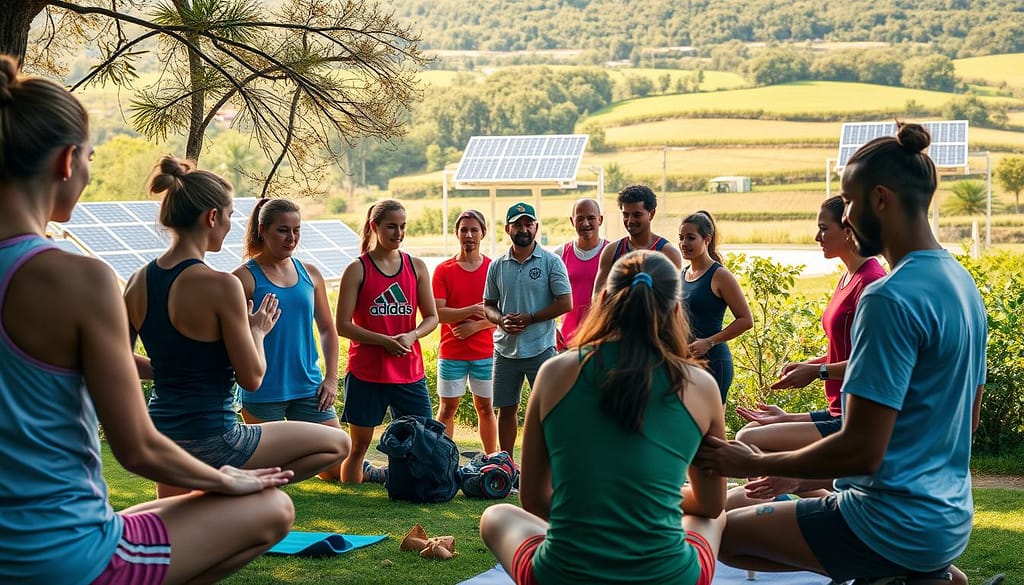
Clubs are now working together like never before. They share resources instead of hoarding them. This means that equipment and facilities are used by more people, benefiting everyone.
Studies show that working together improves programs. In Austin, three basketball teams combined their coaching skills. They created a program that improved player skills across all teams. This kind of collaboration saves money and brings in new investments.
The sharing economy has reached sports. It’s like Airbnb for sports gear and Uber for coaching. Clubs are finding that sharing leads to growth for all. Why should each team start from scratch when they can work together?
This way of working together is called the “collaborative multiplier effect.” One team’s extra resources help another. A swimming program’s pool time helps special needs athletes. A football team’s gym space helps soccer players. The list goes on.
The best partnerships work like a well-oiled machine. Resources flow smoothly, and everyone knows their role. They have clear agreements and schedules. This teamwork makes clubs stronger and the sports world better.
Digital and Physical Sharing Models
Welcome to a new era where your phone and sports bag work together. Clubs now use apps and equipment lockers in perfect sync. It’s like having Netflix but also hanging out with your team.
Digital sharing brings magic: it’s scalable. You get access to 41 different resources with just a tap. No more lost playbooks or excuses. Digital stuff doesn’t get worn out or lost.

But physical sharing has its own charm. It creates a real connection among people. Giving someone equipment they need strengthens bonds. It’s like celebrating a birthday with cake, not just a text.
Research shows solving partnership challenges is simple. Digital platforms handle the technical stuff. Physical sharing focuses on building trust and community.
This mix isn’t just smart; it’s sustainable. We’re building systems that last, for today and tomorrow. It’s like building athletic cathedrals that stand the test of time.
| Model Type | Key Features | Community Impact | Sustainability Factor |
|---|---|---|---|
| Digital Sharing | 41+ template resources, instant access, zero wear-and-tear | Broad reach, 24/7 availability | Reduces physical waste, endless replication |
| Physical Sharing | Equipment libraries, face-to-face exchanges, tangible trust | Stronger bonds, immediate feedback | Extends product lifecycles, reduces consumption |
| Hybrid Approach | Digital scheduling + physical assets, app-based coordination | Balanced engagement, flexible participation | Maximizes resource utilization long-term |
The real magic is when digital and physical models work together. Digital handles the details, while physical builds community. It’s efficient technology with the warmth of human connection. That’s not just sharing; it’s building a community with care for the planet.
This isn’t about picking one over the other. It’s about seeing the value in both digital ease and physical presence. Sometimes, you need an app, and sometimes, you need real equipment in your hands.
Case Examples
Forget hypothetical models – these five case studies show sharing networks in action with staggering results. They’re not just playing nice; they’re playing smart. They use collective power in ways that would make even the most cynical sports economist crack a smile.
Let’s break down the all-stars of resource collaboration. These organizations have turned sharing from a nice idea into a winning strategy.
| Organization | Location | Key Achievement | Scale |
|---|---|---|---|
| Sport for Good Coalition | Chicago | $13 million secured | City-wide impact |
| Philadelphia Youth Sports Collaborative | Philadelphia | 80,000 youth served | 70+ member organizations |
| Play Equity Movement | Los Angeles | Policy to playgrounds | Regional transformation |
| King County Play Equity Coalition | Seattle area | Systemic access solutions | County-wide reach |
| Fight For Children | Washington DC | Youth development focus | Local to national influence |
Chicago’s Sport for Good Coalition didn’t just ask for funding – they negotiated it. Thirteen million dollars materialized because they understood something fundamental: collective bargaining beats begging every time. This isn’t charity; it’s a masterclass in leverage.
Philadelphia’s collaborative takes the quantity-quality dilemma and body slams it. Serving 80,000 youth through 70+ organizations? That’s the administrative equivalent of a perfect game – scaling impact without dilution. Their sharing networks create efficiency that would make Amazon jealous.
LA’s Play Equity Movement turns policy into playgrounds. They understood that legislation without implementation is just paperwork. Their approach reminds me of that famous quote about trees – they’re not waiting for shade, they’re planting now.
King County’s coalition tackles systemic barriers like a seasoned coach adjusting game strategy. They’re not just providing equipment; they’re redesigning the entire playing field to ensure access isn’t dependent on zip code.
DC’s Fight For Children proves that local efforts can have national resonance. They’ve created a blueprint that other cities can adapt – the open-source software of youth sports development.
These case studies demonstrate that effective sharing networks aren’t about scarcity mentality. They’re about baking bigger pies so everyone gets a better slice. The results speak louder than any theory ever could.
Barriers and Opportunities
Even the best plans face obstacles. Sharing resources can lead to turf wars and budget limits. The Sport Partnership Collective shows deeper challenges like skill gaps and power imbalances.
These hurdles are not roadblocks but chances to find new ways. Digital tools make things easier, and clear plans stop shallow involvement. Measuring success can show the value of working together.
Success in teamwork means tackling implementation barriers together. It’s about creating connections where there were divisions. In the end, teamwork wins, leaving solo efforts in the dust.