
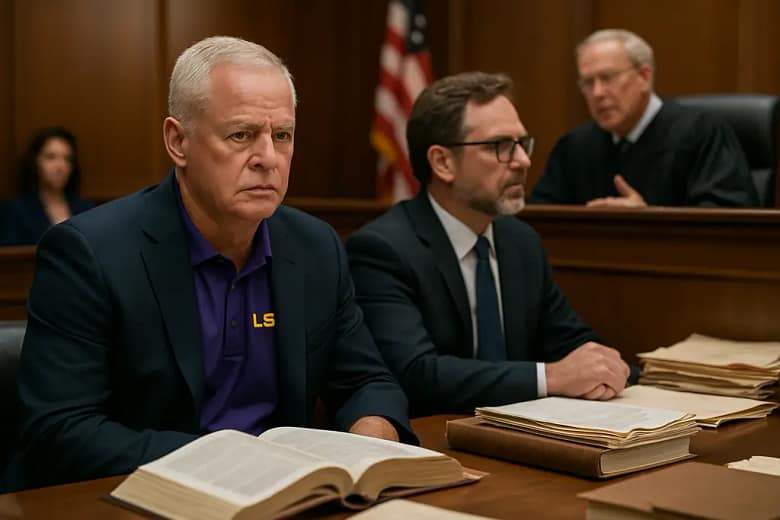
The LSU Roster Violations dispute became a practical test of who sets enforceable standards in college football: a conference, the NCAA, a state court, or the member university that submits the roster. By September 14, 2026, the most severe immediate outcome had not occurred. The Southeastern Conference did not vote to expel LSU after the school finalized a 105-man roster that excluded former NFL signees Zxavian Harris and Dae’Quan Wright. That decision reduced the short-term pressure, but it did not settle the larger governance question.
The facts matter because this was not a routine roster paperwork issue. On September 3, 2026, East Baton Rouge Parish Judge William Jorden issued a preliminary injunction against the NCAA, clearing a path for Harris and Wright to be listed by LSU, according to WHDH’s report. The Southeastern Conference, however, had adopted rules barring athletes who signed professional contracts in the NFL, NBA, or WNBA from returning to college sports; Wright and Harris had signed undrafted NFL contracts and were cut before the NFL regular season, as described by WABE’s coverage.
For education leaders and athletic administrators, the case showed why eligibility standards need more than legal language. They need training, documented sign-off, and repeatable compliance checks before a player appears on a competition roster. In that sense, the episode belongs in the same conversation as coach education, athletic director certification, and conference-level governance audits.
How LSU Roster Violations Reached Court
The dispute moved quickly in early September 2026. The Louisiana injunction limited NCAA enforcement against LSU’s use of former professional signees, but the conference’s position remained separate. The Southeastern Conference sought to enforce its own bylaws, including rules against former professional athletes participating in SEC competition. That distinction is central: a state court ruling against NCAA enforcement did not automatically erase a conference rule.
Why LSU Roster Violations Became A Test Case
The reason LSU Roster Violations became a broader test case was the overlap between legal eligibility and conference membership duties. LSU could point to the injunction as support for listing Harris and Wright. The conference could point to its amended rules and member obligations. Those positions created a governance gap: one authority was temporarily restrained, while another claimed the right to enforce participation standards within its own competition.
On September 6, 2026, LSU opened the college football season with a 51-10 win over Clemson. The school did not include Harris or Wright in the 105-man roster submitted to the SEC. That decision avoided an immediate violation of the league’s eligibility rule and removed the direct trigger for the most severe conference penalties then under discussion.
The Roster Filing Was The Turning Point
The roster filing changed the practical stakes. Before LSU submitted its list, the dispute involved possible sanctions tied to the presence of former professional signees. After LSU excluded the players, the conference’s immediate enforcement case became less direct. Reports in the research record said SEC presidents and chancellors met by video conference on September 10, 2026, and did not take immediate disciplinary action while LSU refrained from placing the players on the roster.
That sequence helps explain the September 11, 2026 decision not to hold an expulsion vote. The conference did not need to resolve every legal argument to step back from its most severe option. LSU’s roster choice narrowed the live dispute, even though litigation and governance questions continued.
Eligibility Rules And Competitive Balance
The Southeastern Conference framed its rules as a matter of competitive balance and shared brand alignment among member schools. The rule at issue barred athletes who had signed professional contracts in specified leagues from returning to college competition in the conference. In practical roster terms, that meant a player cut before an NFL regular season could still fall outside the conference’s eligibility framework.
Why Conferences Guard Participation Standards
Conference rules are not only about who can play. They also define the competitive assumptions shared by member schools. If one school can use athletes with professional contract histories while others follow a different interpretation, conference leaders may view that as a threat to common standards. That concern does not answer every legal question, but it explains why the conference treated the issue as more than a two-player roster dispute.
The case also showed the value of plain-language compliance education. Coaches, roster managers, compliance staff, athletic directors, and presidents need the same operating definition of eligibility before a roster reaches the conference office. A certification-style model would not settle litigation, but it can reduce preventable conflict by requiring documented understanding of rules before competition begins.
Retroactive Rule Concerns
The research record also pointed to tension over rule changes being applied through litigation or after athletes had already made professional decisions. That concern is difficult for college sports because eligibility rules affect player planning, scholarship strategy, and depth-chart construction. A cautious governance system should identify transition rules in writing, especially when a rule affects athletes who signed contracts, were released, and then sought college opportunities.
There is also a communications issue. If rules differ by conference, by court order, or by NCAA interpretation, athletes and schools may receive conflicting signals. That is not healthy for player development or administrative accountability. It increases the need for formal rule briefings that are archived, testable, and available to the people making roster decisions.
Institutional Control As A Sports Standard
The phrase “institutional control” carried major weight in the dispute. According to the research notes, SEC leaders argued that LSU President Wade Rousse and Athletics Director Verge Ausberry lacked meaningful control over Head Coach Lane Kiffin and the football program. That argument moved the issue from eligibility alone to university governance.
Control Means Documented Oversight
In college sports, institutional control is not just a slogan. It refers to whether university leadership can show active oversight of coaches, staff, and athlete eligibility processes. A president or athletic director does not need to make every football decision personally, but the institution must be able to show that rules are understood, enforced, and documented through a chain of responsibility.
This is where education standards become useful. A school can require annual rules training, role-specific compliance modules, written roster approval procedures, and pre-submission certifications by the people responsible for eligibility. Those steps do not guarantee immunity from disputes, yet they create evidence that the institution took governance seriously before conflict reached a courtroom or conference meeting.
Coach Authority Has Limits
The LSU matter also raised a question common across major college sports: how much autonomy should a head coach have in roster building when eligibility rules are contested? A football coach is hired to build a competitive roster, but a university is responsible for membership obligations and compliance. The standard should not depend on personality or program status. It should depend on documented authority, review, and timely escalation when a rule is unclear.
For readers interested in how eligibility debates extend beyond college sports, NBA Playbook provides insights into rule and roster considerations shared across professional basketball leagues.
What College Sports Governance Can Learn
The immediate LSU outcome was de-escalation, not full resolution. That distinction matters. The conference did not proceed with an expulsion vote after LSU excluded Harris and Wright, but the legal filings and governance claims left important issues unresolved as of September 14, 2026. The case showed that college sports rules can be strained when NCAA authority, state court orders, and conference bylaws point in different directions.
Federal Standards Remained Part Of The Debate
The research notes identified renewed pressure for clearer federal frameworks, including proposals such as the Protect College Sports Act, to standardize eligibility, transfers, and enforcement across conferences. The case for standardization is administrative as much as legal. Universities compete nationally, recruit nationally, and face rules that may vary by conference and court venue.
Still, any federal framework would need careful drafting. Eligibility rules affect athlete opportunity, competitive balance, scholarship management, and conference identity. A national standard that is too vague could shift disputes rather than solve them. A standard that is too rigid could limit legitimate conference differences. The LSU episode did not answer that policy debate, but it supplied a concrete example of why common definitions matter.
Training Should Match The Stakes
College sports governance often depends on people making fast decisions under public pressure. That is why training should be treated as infrastructure, not a side task. A football roster is a competitive document, but it is also a compliance document. Before submission, schools should be able to answer basic questions:
- Who verified each athlete’s eligibility under NCAA and conference rules?
- Who reviewed any professional contract history?
- Who had authority to approve exceptions or escalate disputes?
- Who certified the final roster before it went to the conference?
Those questions are not punitive. They are the kind of standards-based practice that protects athletes, schools, and conferences from avoidable confusion.
LSU Roster Violations And Governance Standards
The LSU Roster Violations episode should be read as a governance warning rather than a completed enforcement story. LSU avoided the most severe immediate conference action by excluding Harris and Wright from its 105-man roster, and the SEC did not hold an expulsion vote after that roster was finalized. Those are the clearest practical outcomes from the September 2026 sequence.
The deeper lesson is that college sports needs clearer standards for eligibility interpretation, professional contract history, and institutional control. Courts can affect enforcement. Conferences can assert membership rules. Universities must still prove that presidents, athletic directors, coaches, and compliance officers are working from the same rulebook.
For administrators, the strongest response is not simply stricter punishment. It is better education: annual certification, documented roster review, written escalation steps, and shared definitions across campus leadership. If college football expects athletes to meet eligibility standards, institutions should meet comparable standards of training and oversight.