
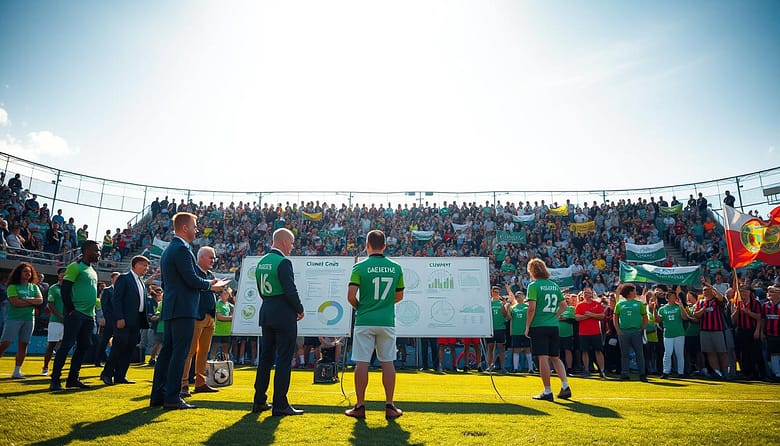
The beautiful game has a dirty secret. With 3.5 billion fans worldwide, football’s carbon footprint is huge. It’s as big as a small European nation’s yearly emissions.
Every year, football emits over 30 million tonnes of CO2. This is more than the 3.63 million tonnes from a single World Cup. It’s a harsh environmental wake-up call.
It’s not just the big games. It’s the daily league matches, travel, and energy use in stadiums. There’s also a lot of waste. Fans want the sport to be more eco-friendly, but many don’t know who to blame.
This is where we need a playbook of precision. We can’t just say we want to be greener. We need clear goals.
Before a team can win, they need a solid plan. The same goes for climate action in football. UEFA wants to cut emissions by 50% by 2030, and FIFA aims for net-zero by 2040. Are these goals realistic or just far off?
True climate action starts with clear, measurable goals. It’s not just cheering for the team. It’s about setting urgent, achievable targets.
Pre-Game Communications and Social Assets
In the digital world of fan engagement, the awareness campaign before the game is key. It’s not just about promoting. It’s about creating a story that gets people involved. The real battle for a team’s environmental legacy happens online, not just on the field.
Young football fans are choosing eco-friendly brands over mainstream ones. This is a big change in culture and business. They’re not just buying tickets; they’re supporting a cause. A good awareness campaign turns a club’s green efforts into a shared goal.

A winning digital strategy uses engaging assets. Think infographics that show how a club’s actions help the planet. Or 15-second TikToks that make eco-friendly choices fun and viral.
Education is key, like promoting green transport. A smart campaign can make eco-friendly choices feel like a team effort. It’s not about sacrifice but about unity for the planet.
Success comes from tapping into fan pride. It’s not about scolding but about joining forces. A good campaign says, “Our fans lead in sustainability. Will you join us?” It uses the power of community spirit, like local sports teams do.
Players are the game-changers. When they share their eco-friendly habits, it makes the mission relatable. It brings the climate issue from the boardroom to the locker room. Clubs like Arsenal are already making sustainability a key part of their legacy, as shown in their reports.
A pre-game awareness campaign is more than just awareness. It’s about starting a movement online before the game. It’s the strategic groundwork that ensures the crowd is united, ready to support a bigger win when the game starts.
The 90-Minute Match: Turning Spectators into Climate Players
The final whistle blows. For the next 90-plus minutes, a stadium turns into its own world. The energy is electric, a shared moment for tens of thousands. This is the moment of truth for fan engagement with a cause.
How do you make a global issue like climate action feel as urgent as a last-minute match-winner? The in-stadium activation is your main event, where messaging turns into experience.
The most effective activations are hands-on and participatory. UEFA’s Euro 2024 initiative offers discounted Deutsche Bahn rail tickets to fans. This is a direct, meaningful action that links fan behavior to a positive environmental choice.
On the club level, Tottenham Hotspur powers their team coaches with biofuel. These are actions fans can get behind because they are visible and understandable.

Then there’s the other side of the pitch: carbon offsets. The idea is tempting—fly the team and its gear around, then offset the emissions. But is it a real solution, or just a way to feel better?
After the 2022 FIFA World Cup in Qatar claimed “carbon neutrality,” the Swiss Fairness Commission ruled the claim was misleading. Offsetting is not a magic eraser. When a club or league’s main climate strategy is to buy cheap credits, it’s greenwashing.
The real game is won by contrasting the tangible with the theoretical. Let’s look at the play-by-play.
| Tangible, On-the-Pitch Action | Carbon Offsets: The Dubious Assist |
|---|---|
| Sustainable Fuel for Team Coaches: Like Tottenham Hotspur using biofuel. It’s a direct, measurable reduction in the club’s operational footprint. | Outsourced Guilt: Paying for a forest to not be cut down, often in the Global South, to “balance” the emissions from a private jet flight. |
| Fan Engagement via Rail Partnerships: Like UEFA’s Deutsche Bahn deal. It provides a clear, better alternative for fans and cuts transport emissions. | Lack of Permanence: A forest protected today can burn or be logged tomorrow, negating the “permanent” carbon storage you paid for. |
| In-Stadium Pledges & Interactive Displays: Halftime prompts for fans to make a climate pledge via their phones, with real-time pledges on the big screen. | Virtue-Signaling with a Credit Card: Allows organizations to claim “net-zero” without changing their core, high-emission operations. |
| Direct Impact: Visible, builds fan trust, educates, and creates a real, local positive impact. | Indirect & Opaque: The link between your flight and a tree planted is abstract, unverifiable for most fans, and lacks the visceral impact of a direct action. |
The choice is stark. One path requires investment, innovation, and changing habits—like switching a fleet to biofuel or building better rail links. The other allows business as usual, with a conscience soothed by a financial transaction. For fans, one feels like being part of a team effort; the other feels like a PR tax.
When the final whistle blows on a match, which legacy do you want your club or event to have? The one that built a railway or the one that bought an alibi?
Community Tie-Ins: Growing Roots Beyond the Pitch
What if the most valuable player on a football club’s roster wasn’t a striker or a goalkeeper, but the community itself? The final whistle may signal the end of a match, but for a football club that gets it, the real game of climate action begins when the stadium lights dim. This is where the global fight against climate change gets local, personal, and powerfully effective.
Consider Cat Jebson, a fan who began by sending emails about vegan pies in the stadium and evolved into a “critical friend” to her club. Her story isn’t an anomaly; it’s a blueprint. Fan-led groups like Burnley’s “Sustainable Clarets” and “Everton for Change” have proven that supporter pressure isn’t just for chanting—it’s a powerful engine for change, pushing clubs from vegan options to ditching plastic bottles. This is the Sage’s first lesson: real change often starts not in the boardroom, but in the stands.
This isn’t just about being green for the optics. It’s about a fundamental shift in a club’s identity within its territory. Brentford FC’s strategy of integrating community gardens isn’t a PR move; it’s a statement that the club’s territory extends beyond the pitch. These initiatives, from tree plantings to river cleanups, are the physical roots of a club’s legacy. They transform abstract climate goals into tangible neighborhood wins: a cleaned-up riverbank where kids can play, or a community garden that feeds local families. It’s a legacy measured not in trophy cabinets, but in mature oaks and engaged citizens.
The Sage archetype sees the deeper connection: these local actions are the frontline of climate justice. Research confirms what we see in the stands—climate change disproportionately impacts the less affluent. When a club in a post-industrial town sponsors a tree-planting drive or a mass cleanup, it’s not just an environmental act; it’s an act of social equity. It grounds the global climate crisis in the local, the tangible, and the just. It says the club is a steward of its place, not just a tenant.
Ultimately, a club’s most enduring climate action might be the community garden it sponsors long after the final whistle. It’s a statement that the club’s legacy isn’t just about the silverware in a cabinet, but the living, breathing community it helps cultivate. It’s a recognition that the most important “player” on the team isn’t always on the team sheet—it’s the community that roots for it, and the environment it calls home.
Athlete Spokespeople and Media Strategy
In sports, an athlete’s voice can be very powerful or risky. The crowd’s cheers are one thing, but a trusted player’s words mean a lot. It’s a tricky media world where being real is key.
Look at Ben Mee, a Premier League defender who talks about his kids and clean sheets. Katie Rood promotes plant-based food in stadiums. And Funso Ojo, who chose an electric car over a Porsche, is a big supporter of going green. These stories really connect with people.
But, there’s a big problem. What if a star player talks about using trains but then flies private for an event? It’s a big issue, as researcher Freddie Daley points out. Fans know when actions don’t match words. When the athlete spokesperson talks about change but the club doesn’t act, it looks fake.
So, what’s the best way to handle it? It’s about being real and consistent:
- Authenticity Over Aesthetics: Use athletes who really care about the cause, like Ben Mee, who fights for his kids’ future.
- Operational Integrity: The club must act like it believes in the message. No private jets for a “green” team.
- Integrated Storytelling: Mix the athlete’s story with the club’s green efforts, as shown in guides like this one on sustainable sports management.
The aim is to create a lasting story where the athlete’s voice is real and shows the club’s true commitment. Without that, it’s just empty words.
Post-Event Reporting and Next Steps
The final whistle blows, and the confetti is swept up. The last fan has gone home. This is when the real work begins. Clubs and federations see the post-event report as the true scorecard.
Leading clubs like Juventus and Manchester City are setting high standards. They treat their sustainability reports with the same care as their match analytics. This is where fan engagement becomes a cycle of measurable action.
Transparency is now the most valuable thing. UEFA’s Carbon Footprint Calculator for clubs is a good start. But managing physical climate risk is the next big step.
When a heatwave forces a water break or a flooded pitch postpones a derby, climate change is real. Tools like EarthScan help quantify these risks. They move the conversation from simple carbon accounting to building true operational resilience.
A recent analysis on tournament footprint reduction shows the future of sports is low-carbon. The true legacy of a tournament isn’t just a trophy. It’s a verifiable, transparent legacy of action. The final whistle on the game is just the kickoff for the long-term strategy.