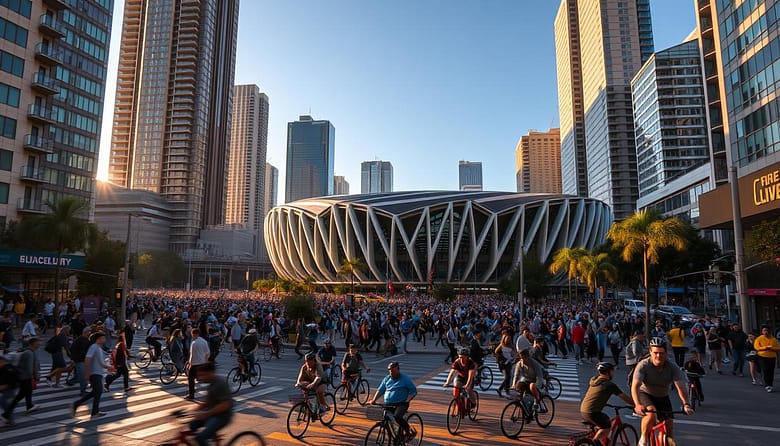
Imagine Olympic torches lighting up Rio’s favelas while cranes are changing Barcelona’s coast 4,000 miles away. Mega-events are more than just sports. They’re urban alchemy, turning cities into dazzling displays. But the real magic happens where you least expect it.
Barcelona’s 1992 transformation is a prime example. What was once industrial waste became a stunning waterfront. It’s a perfect sport event legacy example. But Rio’s 2016 event had a different story. Over 20,000 people lost their homes, showing how stadiums can lead to gentrification.
So, who benefits from these events? City planners seeking fame? Developers looking for prime spots? Or are communities fighting to keep their homes? Let’s explore how stadiums can boost economies and widen inequality gaps.
Urban experts call it “crisis capitalism in cleats.” The outcome? It depends on whether you’re enjoying luxury or protesting against evictions. Either way, cities become monopoly boards for the wealthy.
The History of Sports-Driven Urban Renewal
Long before we had luxury skyboxes and $18 beers, ancient Romans filled the Circus Maximus. It was a 250,000-seat venue that showed how sports could shape cities. Today, we’re doing the same thing, building stadiums that promise economic growth but sometimes fail to deliver.
The modern approach to urban renewal through sports is all about big dreams and political shows. Barcelona’s 1992 Olympics are a prime example. The city turned old industrial areas into volleyball courts, boosting tourism and pride.
But not every city succeeds. Athens’ 2004 Olympics left behind a ghost town, a reminder that not all investments pay off. It makes you wonder: What really leads to lasting change?
| City/Event | Investment | Lasting Legacy | Community Impact |
|---|---|---|---|
| Barcelona 1992 Olympics | $9.4B (2023 adj.) | Beachfront development, transportation upgrades | 20% tourism increase by 2000 |
| Athens 2004 Olympics | $15B | 21 abandoned venues | 0.8% GDP growth post-Games |
| Johannesburg 2010 World Cup | $3.5B | Soccer City Stadium repurposed | 67% residents felt national unity boost |
| Los Angeles 2020 (SoFi Stadium) | $5B | Mixed-use entertainment complex | 14,000 temporary jobs created |
The 2010 World Cup in South Africa showed sports can unite people. Johannesburg’s Soccer City Stadium, built on an old prison site, became a symbol of hope. It’s a powerful example of how sports can transform a city.
Today, stadiums like SoFi are more than just venues. They’re investments in real estate, disguised as sports temples. The real goal is to convince taxpayers that these projects are good for the city, not just team owners.
From ancient chariot races to modern-day stadium naming rights, the goal remains the same. Cities keep investing in sports, hoping for a boost. But, as any expert will tell you, success depends on careful planning and community support.
Urban Planning and Mega-Events: When Sports Become City Architects
Imagine city planners as NFL quarterbacks making quick decisions at the line of scrimmage. Sometimes, they pull off amazing plays that turn old industrial areas into lively spots. Other times, their big investments don’t quite work out as planned.
Infrastructure Investment Paradoxes
Hosting big events like the Olympics creates a big problem for city planners. They have to choose between building fancy venues that might not last or making practical improvements that will benefit the city for years to come. London’s 2012 Olympics found a good balance.
- A 560-acre Olympic Park reborn as London’s largest new green space in over 70 years
- Stratford Station upgrades moving 240K daily commuters
- 5,000 homes in the former Athletes’ Village
Beijing’s 2008 Olympics also made a lasting impact, improving air quality and expanding the metro. But cities often focus too much on building stadiums and not enough on other important projects. It’s like spending too much on fancy rings and not enough on building a strong team.
The Barcelona Blueprint vs. Athens’ Cautionary Tale
Let’s look at two famous examples in sports urbanism:
| City | Event | Infrastructure Focus | Current Use | Legacy Score |
|---|---|---|---|---|
| Barcelona | 1992 Olympics | Coastal regeneration | 7M annual tourists | ⭐️⭐️⭐️⭐️⭐️ |
| Athens | 2004 Olympics | Sports venues | 21 abandoned sites | ⭐️½ |
| London | 2012 Olympics | Transport + housing | 6,000 residents | ⭐️⭐️⭐️⭐️ |
| Beijing | 2008 Olympics | Air quality + transit | 9M daily metro riders | ⭐️⭐️⭐️½ |
Barcelona turned the Olympics into a chance to improve the city, not just host an event. They fixed sewers, created beaches, and made walkable areas that now bring in €3B a year in tourism. Athens, on the other hand, focused too much on sports venues and ended up with many abandoned sites.
Today, city planners have to convince taxpayers that investing in big projects is worth it. But, as London’s Olympic Park shows, the real success comes when sports spaces become lasting parts of the community, not just temporary attractions.
Economic Boosts & Community Investment
Ever wonder why a stadium beer costs $18 and a parking spot seller makes $300 an hour? Sports economics is more than just billionaire owners. It’s a game where taco trucks and construction cranes meet. Follow the money from luxury suites to street vendors, with twists even Succession wouldn’t script.
From Hot Dog Stands to High-Rises
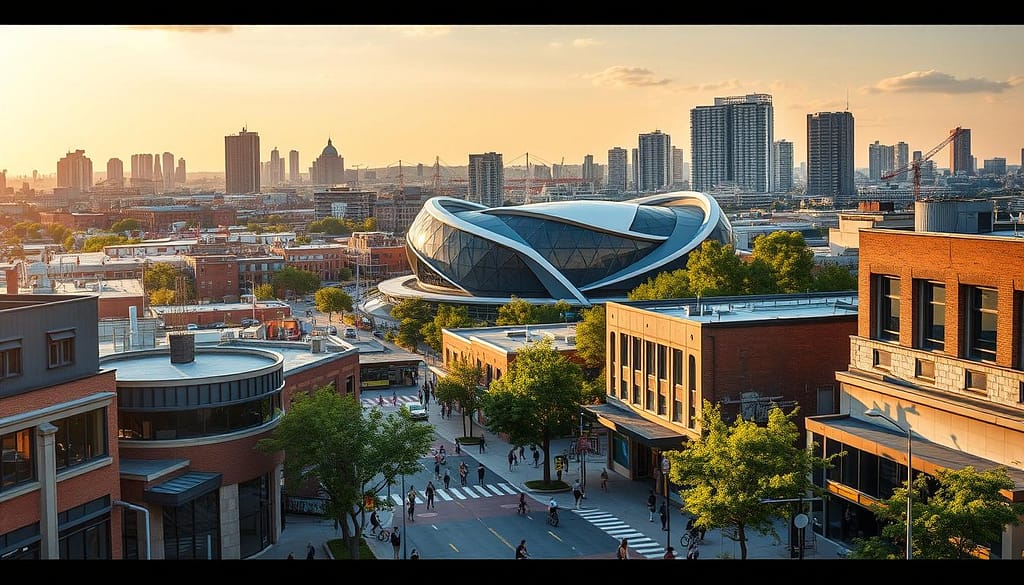
The real MVP of any major event? The immigrant-owned food cart feeding construction crews at 5 AM. In Atlanta, the Westside revival is a prime example. Mercedes-Benz Stadium dazzled tourists, while local activists pushed for community benefits agreements.
These agreements ensured 31% of contracts went to minority-owned businesses. The result? A $1.6B development created 4,000 jobs. And it kept the neighborhood’s fried chicken joints alive.
In Phoenix, 2023 saw a food waste program turn stadium nacho mountains into farm soil. They called it “compost capitalism.” Their secret? Partnering with women-led startups to transform 18 tons of garbage into urban gardens. It’s a halftime show for sustainability.
The Amazon HQ2 of Sports Economics
Remember when cities offered tax breaks to Amazon? Sports complexes are the new HQ2. Consider:
- Super Bowl LVI’s $700M economic bump vs. Athens’ $15B Olympic debt hangover
- 3,200 temporary jobs during SoFi Stadium construction vs. 84 permanent positions afterward
- $4M annual revenue from Atlanta’s Westside tax district funding youth sports programs
The real game-changer? How cities use these projects for sports-driven women empowerment. Atlanta’s redevelopment created a co-op where female entrepreneurs turn stadium banners into handbags. It tackles income inequality and bad fashion choices.
As one Westside organizer said: “We’re not against progress – we just want our cut of the $18 pretzels.” Touchdown.
Infrastructure and Green Space: Lasting Legacies
Imagine a city where Olympic podiums are made from recycled soda bottles. Rivers once polluted now welcome kayakers. Welcome to a world where sports green spaces are more than just decoration. They’re essential for city survival.
Host cities now see legacy as more than just winning gold. It’s about what stays after the games end.
Parks Over Parking Lots
Stadium districts used to be concrete jungles. Now, they’re green spaces. Paris is spending $1.5 billion to clean the Seine, aiming to make it swimmable. This is not just urban planning; it’s magic.
Here are three ways cities are changing:
- De-paving parties: Turning parking lots into gardens for pollinators
- Vertical forests: Plant walls on stadiums to absorb CO2
- Rainwater racetracks: Using stormwater to fill Olympic pools
Tokyo’s Plastic Podium Revolution
Tokyo 2020 was a recycling milestone. The podiums were made from 24.5 tons of plastic. It’s like a victory for the environment. Ninety-nine percent of waste was recycled.
| City | Initiative | Materials Recycled | Post-Game Use |
|---|---|---|---|
| Tokyo | Plastic podiums | 400k detergent bottles | Community benches |
| Paris | Seine cleanup | N/A (water focus) | Public swimming zones |
| London | 2012 Park design | 98% demolition waste | Urban wetlands |
This isn’t just for show. Treating green infrastructure as key to success is vital. It’s about being relevant in the face of climate change. The question is, can we afford to keep things the same?
Socio-Political Impacts on Urban Communities
Behind the shine of big events, cities often swap homes for fancy venues. How many city planners does it take to change a lightbulb? It’s a trick question. They’d prefer to light up stadiums that blind whole areas. Let’s uncover the sad truth of city planning sports and how it pushes people out.
Gentrification’s Hail Mary Pass
The 2016 Olympics in Rio de Janeiro set records, but also eviction records. Sixty-five thousand people lost their homes. Imagine bulldozers coming at dawn while developers enjoy drinks in fancy boxes.
One stadium means three favelas cleared. It’s a harsh math.
| City | Event | Displaced | New Luxury Units |
|---|---|---|---|
| Rio de Janeiro | 2016 Olympics | 65,000+ | 12,500 |
| Los Angeles | 2028 Prep | 8,400 encampments cleared* | 4,200 (projected) |
*Source: LAHSA 2023 Homelessness Statistical Report
The Eviction Playbook
Here’s how the game is rigged:
- Zoning Law Chess: Overnight changes turn homes into “commercial zones”
- Community meetings during work hours – ignoring democracy
- Security sweeps that are faster than Olympic athletes
But there’s a twist. Grassroots groups are fighting back. In LA, skateboard groups turned Olympic lots into sports for minorities training spots. Minneapolis used World Cup sites for Somali youth leagues and community markets. The goal? Urban renewal that keeps people, not pushes them out.
Environmental Considerations
Imagine a World Cup stadium made of shipping containers that vanishes after the game. Sounds like a dream? It’s like the Schrödinger’s cat of urban planning – events that promise to be “green” but leave a huge carbon footprint. Let’s look at the gap between environmental promises and the real industrial impact.
Carbon-Neutral Tailgating
Sports complexes today are complex, like an onion. Qatar’s 2022 World Cup is a prime example. Their compostable stadiums were Instagram-worthy, but 80% of waste came from building them. It’s like recycling a Coke can after cutting down a rainforest.
Greenwashing tactics include:
- Carbon offset programs that feel like medieval indulgences (“Forgive me FIFA, for I have flown 500 private jets”)
- Temporary air quality improvements (Beijing closed factories during the Olympics… then quietly reopened them)
- “Legacy green spaces” that become parking lots by season three
Qatar’s Waste Audition
Qatar’s sustainability report is a magic trick. They recycled 60% of tournament waste – impressive, but 60% of 25,000 tons generated monthly is a lot. Their stadium cooling systems alone used enough energy to power a small nation, showing “eco-friendly” and “desert air conditioning” don’t mix well.
| Event | Green Claim | Reality Check |
|---|---|---|
| Qatar 2022 | Modular, reusable stadiums | 1.5 million tons CO2 from construction |
| Beijing 2008 | 62% emission reduction | Post-event factory emissions doubled |
| LA 2028 | 100% renewable energy | Relies on 5-year-old solar credits |
Real MVPs are cities that link sports mental health programs to green infrastructure. Portland’s urban forests see 40% more use than traditional parks. Trees might be better therapists than most halftime speakers.
Urban Challenges: Gentrification, Displacement
Imagine a city as a Monopoly game. Stadiums bring instant gentrification, turning areas like Baltic Avenue into Boardwalk. In Atlanta’s Westside, home values jumped 300% after Mercedes-Benz Stadium opened. Working-class homes turned into luxury rentals in no time.
The Affordable Housing End Run
City planners often try to add affordable housing too late. Atlanta’s 2017 Super Bowl promise of 2,000 affordable units turned into 200. Absentee landlords then raised prices, making homes unaffordable. Now, Zillow listings show homes priced like Super Bowl tickets.
Airbnb’s Overtime Win
Short-term rentals have become a major gentrification tool. In Munich’s 1972 Olympics, athlete housing became permanent homes. Today, Atlanta’s Westside has 1 Airbnb for every 4 residents. This “hotelification” pushes out long-time tenants, making homes unaffordable.
| City | Sports Infrastructure | Affordable Housing Policy | Displacement Rate |
|---|---|---|---|
| Atlanta | Mercedes-Benz Stadium | 10% tax rebate for developers | 42% increase (2017-2023) |
| Munich | 1972 Olympic Village | 70% legacy housing conversion | 8% decrease post-Games |
| Rio de Janeiro | 2016 Olympic Park | Zero enforceable mandates | 67% favela displacement |
But, there are solutions. City planning sports can be inclusive. Munich shows that sports can help everyone, not just the wealthy. It’s time for cities to get it right.
What Makes for Sustainable Urban Success?
When the final whistle blows on mega-events, cities face their toughest opponent: the accountability clock. Let’s cut through the greenwashing haze and locker-room pep talks to examine what separates gold-medal urban strategies from participation trophy projects.
The Post-Game Playbook
Forget “build it and they will come.” The new playbook demands: “Build it so they’ll stay – and thrive.” Barcelona’s post-Olympic strategy turned waterfront industrial zones into tech hubs, while Sydney transformed Olympic Park into a carbon-neutral neighborhood. Both leveraged their Olympic urban impact, but with different MVP approaches:
- Barcelona: Converted 85% of Games infrastructure into permanent assets
- Sydney: Achieved 70% energy reduction across legacy venues
- Both: Created 15,000+ permanent jobs through smart reinvestment
Sydney’s 30-Point Green Plan
Australia’s 2000 blueprint didn’t just raise the bar – it greened the entire high jump. Their secret sauce? Mandating that every dollar spent on stadiums funded three dollars in green infrastructure. The results:
| Metric | 2000 Target | 2023 Reality |
|---|---|---|
| Public Green Space | 35% increase | 42% achieved |
| Renewable Energy Use | 50% venues | 93% district-wide |
| Affordable Housing | 1,000 units | 3,200+ created |
Here’s the kicker: Sydney’s plan achieved this by empowering communities through sports, turning Olympic volunteers into neighborhood sustainability ambassadors. Their Community Return on Investment (CROI) metric now tracks everything from park access to local business growth – proving stadiums can be measuring cups for social progress.
So what’s the final score? Sustainable success requires cities to:
- Lock in legacy funding before breaking ground
- Make green space non-negotiable in zoning deals
- Turn event volunteers into permanent community stewards
As Barcelona’s mayor famously quipped during our whiteboard session: “We don’t need more Field of Dreams. We need Playbooks of Reality.” Game on.
Future Directions
Urban planners are now experts at 4D chess with holographic pieces. They mix city planning sports with cutting-edge tech. This combo changes plans faster than ChatGPT writes papers. Let’s explore tomorrow’s stadium designs.
Modular Stadiums & Digital Twins
Las Vegas’ Allegiant Stadium shows what’s possible. It changes like a Transformer, with a field that rolls out for events. Paris 2024 goes even further with 95% temporary venues.
Stadiums could be like IKEA furniture, easy to set up and take down. This is good for cities that don’t want big, expensive stadiums.
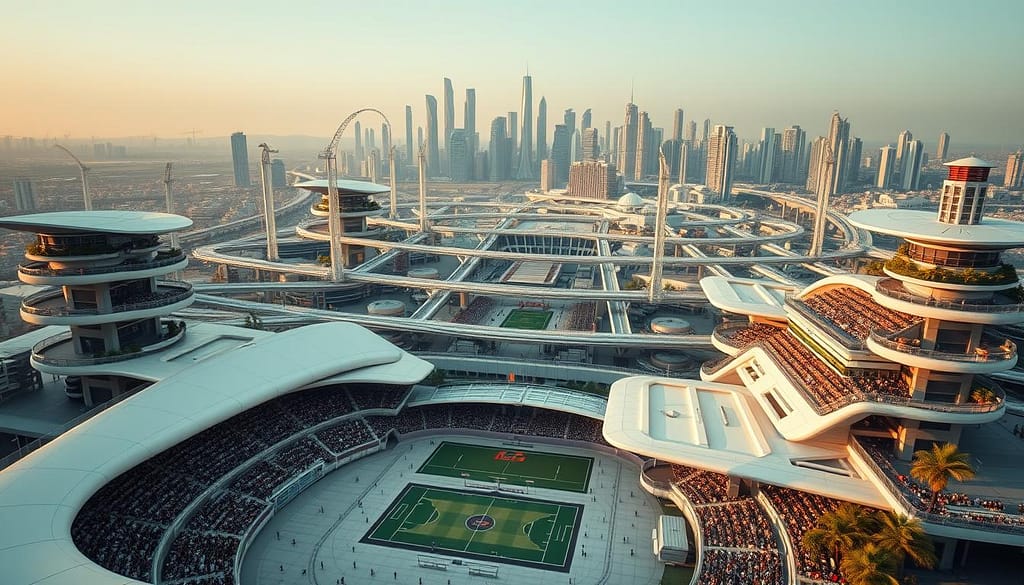
Digital twins are another innovation. They let planners test designs under extreme conditions. Boston’s Fenway Park has a digital twin that simulates everything, from beer lines to emergency exits.
The Metaverse Marathon
Why build physical Olympic Villages when you can create them as NFTs? The sport event legacy of tomorrow might be in metaverse hubs. Here, fans in VR can discuss zoning laws with AI versions of Jane Jacobs.
Paris 2024 is already using blockchain for donations. This turns civic pride into tradable assets.
Imagine your Fitbit data getting you better stadium seats. Cities could make sports physical health a game. Run 10K and get playoff tickets. Miss your goal? You get nosebleed seats.
The goal is stadiums that change as fast as TikTok trends. Your morning jog could fund parks. Game on.
Conclusion: Building Cities for All
Sporting events do more than just build stadiums. They change how cities work. Barcelona’s 1992 waterfront makeover showed how stadiums can start cultural changes. But, Rio’s 2016 showed the dark side of big dreams.
The results are mixed. London created 30,000 jobs, but Athens’ venues are empty. This shows the ups and downs of using sports to improve cities.
Building cities through sports is like playing a game of chess. It’s about making choices that last. London improved its transport, while Rio displaced 65,000 people. The key is to make temporary events last forever.
Barcelona turned Olympic areas into lively neighborhoods. South Africa’s World Cup brought in $3.6 billion without leaving empty stadiums. This shows the power of smart planning.
Real success comes when cities see infrastructure as a community asset. Imagine stadiums that become homes after the games. Or tailgating areas that turn into parks. Urban studies show that success means more than just entertainment.
The game is almost over. Will cities focus on grand facades or on making life better for everyone? The real win is in making cities better for all, not just the skyline.