
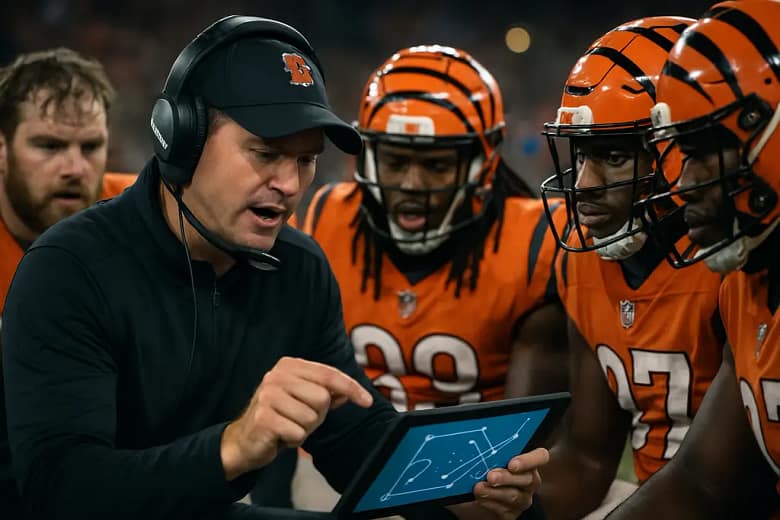
Bengals Coaching Continuity became a clear case study on June 22, 2026, when Cincinnati retained head coach Zac Taylor and player personnel executive Duke Tobin for the 2026 season after a 6-11 record in 2025 and a third straight season without a playoff berth, as reported by NFL.com. For an education-focused review, the decision is best assessed through standards: what stayed the same, what improved, what still required proof, and which measures should carry the most weight.
Retention in football can be misread as passivity, but it can also reflect an organization choosing continuity over another reset. The Bengals case is useful because the record and the internal performance indicators moved in different directions. The win-loss result was poor. The late-season defensive data showed progress. The offense retained important system familiarity. Those facts do not settle the debate, but they provide a structured way to study it.
For coaches, athletic directors, and certification programs, this type of case matters because it separates process from slogans. Staff stability should not be praised only because it feels patient, and turnover should not be treated as accountability by itself. A standards-based review asks whether the retained staff has evidence of correction, whether player development is visible, and whether the organization has set a fair measurement window.
Bengals Coaching Continuity As A Decision Point
What Bengals Coaching Continuity Retained
The June 22, 2026 decision kept two major football leadership posts in place: Taylor on the coaching side and Tobin on the player personnel side. That combination matters because coaching plans and roster construction are linked. A head coach can maintain terminology, teaching progressions, practice expectations, and game-planning habits. A personnel executive can support that plan by identifying players who fit the staff’s usage patterns. The research does not prove that this alignment will produce a better record, but it confirms that Cincinnati chose to preserve the central football structure after the 2025 season.
A Cautious Reading Of Ownership Confidence
The Bengals’ ownership expressed confidence in Taylor’s ability to build a team that contends for championships, according to Yahoo Sports. That statement helps explain the retention decision, but it should not be treated as performance evidence on its own. Confidence is a governance signal. The stronger evidence comes from field-level measures: defensive improvement after the bye, offensive continuity, and player development indicators. In a standards course, those categories would be separated so that decision-makers do not confuse institutional belief with verified results.
That distinction is especially useful for fan discussion. A 6-11 season carries clear weight, and missing the postseason for a third straight year is a serious outcome for a club with established offensive talent. Retaining staff after that result raises the burden of proof. The case for patience depends on whether the same staff can show that problems were identified and reduced before another major reset became necessary.
How Stability Shows Up On The Field
Defensive Markers After The Bye
Defensive coordinator Al Golden was hired on January 23, 2025, and was confirmed on January 5, 2026 to return for a second season. The research notes a measurable shift after the midseason bye in 2025. Over the final eight games, the defense allowed 9.3 fewer points per game than it did in the first nine games, and it allowed 97.1 fewer yards per game. In that final eight-game stretch, Cincinnati ranked seventh in the NFL in points allowed per game at about 17.9, tied for fifth in takeaways with 12, and fifth in opponent third-down conversion rate at about 36.3 percent.
Those numbers do not erase the full-season record, and they do not prove that the defense had become fixed. They do show a late-season correction that can be tested through staff retention. If a coordinator installs terminology, role definitions, and weekly teaching points across one season, a second season can reveal whether the late gains were durable or simply a short run of improved results. The Bengals’ choice gave that question an answerable framework.
Offensive Carryover And Line Stability
The offensive side gives the case a different shape. The research notes that Cincinnati had one of the AFC’s top passing attacks when Joe Burrow was healthy, led the AFC in touchdown passes, and entered the 2026 planning period with the same offensive system and returning starters cited as advantages. All five offensive line starters from the end of the 2025 season were expected to return for 2026, which Taylor described as removing an excuse tied to prior rotation, early sacks, and communication issues.
That point is valuable for coaching education because offensive line play often reflects shared language as much as individual talent. Calls, protections, handoffs on stunts, and timing in pass sets are taught through repetition. The research does not provide a 2026 result for that group, so the fair statement is limited: Cincinnati entered the 2026 season with more line continuity than it had in prior periods, and the staff expected that stability to reduce communication problems.
The 2024 offensive evidence also gives context. Burrow set Bengals single-season records for attempts, completions, yards, and touchdown passes, while Ja’Marr Chase won the receiving Triple Crown by leading the league in receptions, receiving yards, and touchdown catches. Those achievements came with the same core staff and system in place. A cautious analyst should not carry those numbers forward as a promise, but they do show that the retained system had previously produced elite passing output.
Education Standards For Staff Retention

A Grading Rubric For Fans And Programs
Bengals Coaching Continuity should be judged with a rubric rather than a single emotional reaction to the 2025 record. In coaching certification settings, the Bengals case can help instructors teach how to weigh competing evidence. The key is to define the measures before evaluating the decision, not after the preferred answer is chosen.
- Outcome Standard: The 6-11 record and missed playoffs are negative markers that must remain central.
- Correction Standard: The final eight defensive games showed lower points allowed, lower yards allowed, more takeaways, and better third-down performance than earlier in 2025.
- Continuity Standard: The offensive system, line group, and leadership structure were kept together for the 2026 season.
- Development Standard: Young players must show role growth that connects coaching plans to on-field production.
- Accountability Standard: Retention should lead to clearer benchmarks, not reduced scrutiny.
This framework is not designed to defend or attack Cincinnati’s decision. It is designed to make the evaluation teachable. Readers comparing sports topics across the same network can also use wikiapp.org as an entry point for references, but the Bengals case should be graded on football evidence first.
Player Development As Evidence
Player development is one of the harder categories to measure from the outside, but the research gives one clear example. Safety Jordan Battle, a third-round pick in 2023, led all NFL defensive backs in tackles in 2025 and was among the defensive backs with at least four interceptions and at least 100 tackles. That does not assign credit to one coach or one staff member alone. It does show that a young defender produced at a level worth including in the retention discussion.
For education programs, this is where standards and humility should meet. A player’s output can reflect scouting, scheme fit, position coaching, health, opportunity, and personal growth. The best teaching model does not overclaim. It asks whether the staff created repeatable roles for developing players and whether those roles produced more than isolated examples.
Bengals Coaching Continuity As A Teaching Case
What This Case Can Teach
The most useful lesson from Cincinnati is that coaching retention is not a verdict by itself. It is a structured bet on process, teaching carryover, and targeted correction after failure. The Bengals kept Taylor, Tobin, and Golden in place despite a disappointing 2025 record, and the justification rests on a mix of ownership confidence, late defensive improvement, offensive familiarity, and selected player development evidence.
Bengals Coaching Continuity should therefore be studied as a measured accountability case. The record created pressure. The late defensive data created a reason to test continuity. The offensive system had prior high-end results with Burrow and Chase. The retained staff did not receive a blank check in analytical terms; it received a chance to prove that continuity could convert teaching, roster alignment, and late-season correction into more reliable football performance.