
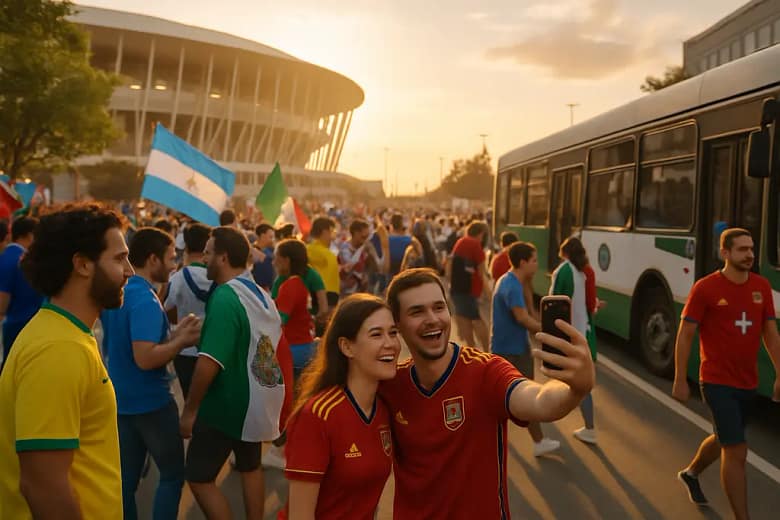
The 2026 FIFA World Cup has been a live stress test for World Cup Mobility in U.S. host cities as of October 14, 2026. For the sport, the stakes are practical: kickoff arrivals, post-match egress, accessible routes, worker travel, transit staffing, and fare design can shape whether a global soccer event feels open to the public or tilted toward people with money, cars, and local knowledge. From an athlete-rights and sustainability perspective, mobility is not a side issue. It is part of the duty cities accept when they host a tournament built on players, supporters, volunteers, and service workers moving at the same time through shared public systems.
The clearest lesson from the 2026 U.S. host-city experience is cautious rather than celebratory. The tournament pushed cities to speed up, organize, and fund transportation plans, but it did not consistently create new fixed-guideway transit systems. That matters because soccer events of this scale often arrive with big civic promises. The evidence from U.S. cities points to a narrower result: operational changes, station work, corridor upgrades, traffic management, temporary shuttle service, and extended service hours carried much of the load.
World Cup Mobility Started With Existing Systems
Robert Sroka’s July 23, 2026 study found that the 2026 tournament in the U.S. and Canada mostly adjusted timelines for existing transit projects rather than producing entirely new fixed-guideway systems, with host cities leaning on corridor upgrades, station improvements, and operational changes Sroka study. That finding fits the political and financial reality of U.S. metropolitan transportation: stadium districts, transit agencies, state departments of transportation, police, emergency services, and local governments often sit in different chains of command.
World Cup Mobility As Schedule Acceleration
The sport benefited where agencies used the tournament calendar to force decisions that had already been debated. Station improvements, traffic signal coordination, bus staging, fan information, and emergency operations can be delivered faster than a new rail line. That does not make them minor. A supporter trying to reach a match, a stadium worker leaving late at night, or a family with a disabled traveler will feel the difference between a staffed station and a poorly marked transfer.
Why Fixed-Guideway Expansion Was Limited
Large transit construction is expensive, slow, and exposed to permitting, funding, procurement, and land-use conflicts. The 2026 experience shows why host-city claims should be judged against delivery windows. A tournament can sharpen deadlines, but it cannot erase the lead time required for new rail corridors. That is a useful lesson for future bids: mobility promises should be separated into what can be delivered before kickoff, what can be tested during event operations, and what can serve residents after the tournament period.
Stadium Geography Set The Hardest Test
Venue location shaped the hardest mobility problems. Several U.S. stadiums used for major matches sit far from central business districts or away from the strongest transit networks. That geography created higher costs for shuttles, longer fan trips, more dependence on managed traffic, and tougher access questions for nonlocal visitors. The issue is not whether suburban stadiums can host. The issue is whether the public agencies and event organizers account for the real cost of moving match crowds without pricing out lower-income fans.
Remote Venues And Last-Mile Costs
New York/New Jersey showed the pressure clearly. MetLife Stadium is about nine miles from Manhattan. NJ Transit first proposed a $98 round-trip train fare for World Cup match travel, far above the regular fare of under $13, to help offset an estimated $48 million in extra transit costs linked to the event. After public backlash, the fare was reduced, though it still remained several times the normal cost. That episode made pricing transparency a social-impact issue, not just an accounting question.
Return options also mattered. The planned shuttle bus service from MetLife Stadium was reduced to a $20 round trip after an earlier $80 proposal, with roughly 12,000 to 18,000 bus seats per match. In Boston, Dallas, Miami, and New York, shared shuttle services in 50-seat vans were also expanded, with fares reported in the $45 to $49 range depending on city. Those services may help fill gaps, but they do not replace affordable public transit if the goal is broad access.
Opening Weekend Traffic Signals
Early traffic data from May 31 to June 1, 2026, showed how quickly pressure built near venues. In Los Angeles, the San Francisco Bay Area, New York/New Jersey, Boston, Houston, Dallas, and Philadelphia, pre-game traffic speeds within one mile of some stadiums dropped nearly 50 percent below normal. That does not prove failure by itself; major sports events always compress demand. It does show that crowd travel had to be managed as a matchday performance factor, much like pitch conditions or stadium security.
Operations Became The Infrastructure Story
For many host cities, the most meaningful infrastructure was operational: who made decisions, which systems shared data, how agencies communicated, and whether staff had authority to adapt during matchday surges. These are less visible than new tracks or bridges, but they often decide whether fans clear a platform safely, whether emergency vehicles can move, and whether roads recover after full-time.
Incident Command And Real-Time Management
The November 2025 host-city peer exchange identified several practical examples. Philadelphia adopted an integrated incident-command structure bringing together transport, police, emergency services, and venue operations. New Jersey DOT upgraded infrastructure around MetLife Stadium with CCTV, roadside units, and fiber networks. Georgia DOT used a Kinetic Mobility platform connecting signals, digital message signs, incident feeds, and other information into a single dashboard.
Those examples point toward a disciplined model: manage the event as a shared public-safety and mobility operation, not as a stadium-only problem. That is especially important in soccer, where supporters may arrive in waves tied to kickoff, national-team rituals, security screening, and post-match celebrations. Readers can explore more community-sports insights from the broader network at Texas Sportsmen, a related site in the same network.
Federal Operating Support
The federal role was also tied to operations. The U.S. Senate report for the 2026 Transportation, Housing and Urban Development appropriations bill directed about $78.1 million for operational transportation assistance to host cities, including capacity, extended service hours, staffing, and transit security Senate report. That funding category is telling. It recognizes that the event burden is not only concrete and steel; it is drivers, dispatchers, police coordination, signal timing, crowd control, and late-night service.
Social Impact Depends On Access And Trust

Mobility plans affect who gets to participate. High transit fares, unclear shuttle information, inaccessible walking routes, and poorly timed service can shut out fans even when they hold a ticket. They can also burden workers whose shifts start before gates open or end long after the final whistle. A sports-first public plan should treat these groups as part of the event, not as background traffic.
Affordability For Fans And Workers
Sticker shock around fares showed how quickly public trust can erode. Host cities and agencies need to explain early who pays for expanded service, how prices are set, and what lower-cost options exist. That is not a public-relations preference. It is a fairness issue. If cities use public streets, public police, public transit staff, and public funds to support a private-ticketed international event, residents deserve clear information about costs and benefits.
Accessibility As Legacy
Seattle-area legacy commitments focused on walkability, sustainable mobility, and accessibility around central event locations, with an intent to include all parts of the community in the event experience. The value of that kind of planning depends on whether changes remain useful after the tournament: safer crossings, clearer wayfinding, better station access, and bus-priority measures can serve daily riders long after match crowds leave.
The 1994 U.S. World Cup offers a useful contrast. The country hosted with large existing stadiums in nine cities, each with capacity of at least 53,000, avoiding major new stadium construction. Yet long distances among venues meant some teams flew more than 2,000 miles between match sites. The lesson still applies: venue readiness can reduce construction needs, but host geography can increase travel burdens.
World Cup Mobility Lessons For U.S. Hosts
The main lesson is that cities should be honest about what a tournament can and cannot do. A World Cup can accelerate plans, test agencies under pressure, and fund targeted operations. It is less likely to create a new transit network from scratch. Those World Cup Mobility lessons should shape future bidding, not after the fact, but before stadiums are selected and before public promises are made.
- Start with venue geography: central, transit-connected stadiums reduce cost and access barriers.
- Price transportation early: fares, parking, and shuttles should be public before backlash sets the terms.
- Fund operations, not only projects: staffing, security, dispatch, and late service decide matchday outcomes.
- Keep legacy practical: walkability, accessibility, station upgrades, and signal systems should serve residents after the event.
A related Back2Tap analysis of World Cup infrastructure legacy reaches a similar sports-business question: public value depends on what remains useful when tournament demand fades. For U.S. host cities, the mobility record through October 14, 2026 is mixed but instructive. The best plans treated soccer supporters, workers, residents, and accessible-travel needs as part of one public system. The weaker plans exposed a familiar gap between world-class event ambition and day-to-day transit capacity.