
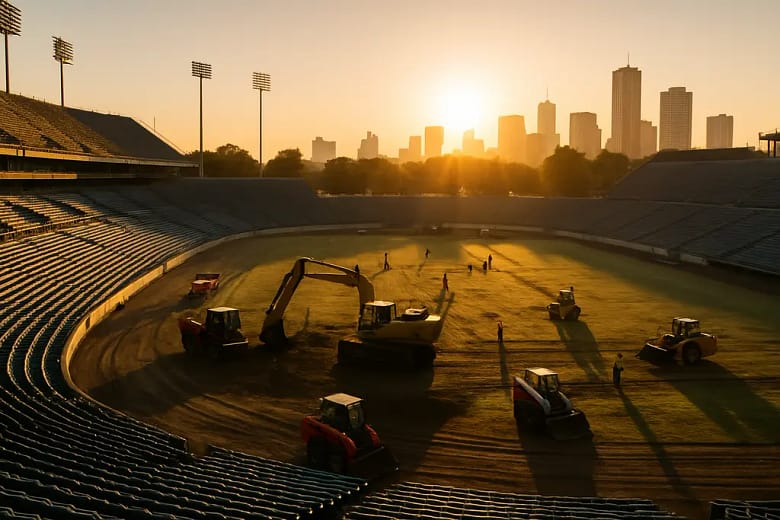
As of October 15, 2026, the Jaguars schedule has become more than a football calendar. It is also a construction-management tool for the Stadium of the Future project at EverBank Stadium. The key sports question is not only where Jacksonville plays, but how the club, the NFL, stadium operators, and construction crews protect game operations while keeping a major venue renovation on track.
The available research supports a cautious reading: Jacksonville did not simply abandon its home venue during the 2026 NFL season. Instead, Jaguars management adjusted the plan so the team could remain in Jacksonville in 2026 at reduced capacity, then relocate for the 2027 season while construction intensified. That approach kept regular-season football in the city for one more year, but it also forced changes in seating, ticketing, game-week work stoppages, and mid-season venue access.
For an education-focused sports audience, the case is useful because it shows how venue standards, fan communication, and fixture planning intersect. Stadium construction is not separate from sport. It affects home-field routines, travel patterns, premium seating, access routes, and the rhythm of a team’s season.
How The Jaguars Schedule Creates Work Windows
Construction on the Stadium of the Future began in February 2025, with the full renovation targeted for completion by August 2028, according to the team’s official Jaguars Stadium of the Future hub. The project’s timing placed the 2026 NFL season in a sensitive middle period: the building was usable, but not in its normal configuration.
Jaguars Schedule And The Mid-Season Gap
The central adjustment was the pursuit of a “donut schedule,” meaning home games clustered more heavily in the early and late parts of the season, with a longer mid-season stretch without games at EverBank Stadium. The reason was practical. Construction crews needed uninterrupted access to areas inside and around the stadium that could not be worked on freely during NFL game weeks.
That Jaguars schedule shape tied directly to the club’s London commitment. The plan included two home games in London during the 2026 season, one at Tottenham Hotspur Stadium and one at Wembley Stadium. The research also says the team requested a bye week after the second London game. If paired with a road game before or after the London-bye period, that structure could create nearly a month-long work window at EverBank Stadium. The research brief does not provide a final week-by-week chart, so the safest interpretation is that the club sought to convert international travel and the bye into construction time rather than treating those weeks as separate scheduling issues.
Why A Month Without Home Games Matters
In normal NFL operations, a home game affects the stadium for more than one day. Crews prepare seating areas, concourses, security perimeters, broadcast zones, team spaces, concessions, and fan-entry points. A major renovation adds another layer. Workers may need to secure materials, cover work zones, shift equipment, and clear circulation paths before fans arrive.
For construction teams, a multi-week period without home games allows larger tasks to be staged with fewer interruptions. The research identifies steel work for the canopy support frame, new staircases, and expanded concourses as visible parts of the construction period. Those are not cosmetic changes from a game-day operations standpoint. They touch fan movement, safety barriers, sightlines, and the areas that must be certified as ready before a crowd enters.
Fan Access And Ticketing During Construction
The most direct fan impact in 2026 was capacity. The stadium was reduced to approximately 42,465 seats from around 68,300, with 27,308 seats taken offline. Most of the offline seats were in the upper bowl, also described as the 400 level. The research also states that all upper-level seats were offline for 2026, while some lower-level seats, select rows, and premium suite areas were affected.
Reduced Capacity Changed The Home Inventory
That reduction made ticketing a major part of the renovation story. Season ticket members in displaced locations were offered relocation opportunities or renewal in sections that were not displaced. In practical terms, the stadium construction did not only move concrete and steel. It moved people, habits, and long-standing game-day routines.
For fans comparing this project with other sports venue redevelopments, the team’s 2026 choice carried trade-offs. Keeping games in Jacksonville preserved local access to NFL football, but the smaller seat inventory meant fewer standard home seats. The related Back2Tap analysis of EverBank Stadium renovation impacts tracks how those changes connect to fan comfort, finance, and city risk.
Education For Fans Became Part Of The Build
Clear communication matters in a season like this because fans need to understand why their section changed, why a usual route may be blocked, and why a familiar concourse experience may look different. Standards-based communication is especially valuable in sports venues because the public sees the final event, not the months of planning behind it.
For readers who follow venue education and sports-reference projects across related properties, Wikiapp acts as a valuable resource, providing a broader scope for discovering related topics. In the Jaguars’ case, the teachable point is simple: stadium projects succeed or fail in part on whether fans can understand the operational rules before they arrive.
Operational Standards Around Game Days
Game-day standards became especially visible during the 2026 season. Construction work was paused around games, generally four to eight hours before kickoff, with some cases shutting down as early as 48 hours before a game and resuming afterward, according to an NFL.com renovation report. That window shows why the football calendar and construction plan had to be aligned.
Work Pauses Protect The Event Window
The pause period is not merely a courtesy. NFL games require controlled public access, broadcast readiness, team movement, emergency planning, and crowd management. Construction materials, temporary barriers, and heavy equipment must be accounted for before gates open. A project can move quickly during the week, but the venue still has to behave like a professional football stadium on game day.
This is where the Jaguars schedule became a planning framework. Each home game created a deadline for crews to secure work areas. Each non-home week created breathing room. The London games and potential bye placement gave planners a chance to reduce the number of full stop-start cycles in the middle of the season.
Visible Construction Did Not Mean Open Construction
Fans in 2026 could see signs of the renovation, including new staircases, expanded concourses, and steel trusses tied to the canopy support frame. That visibility can create confusion if spectators assume active work continues the same way on game day. The more accurate reading is that the building remained a controlled sports venue during events, with construction staged around the NFL calendar.
From a sports-operations education standpoint, this is a useful distinction. A stadium under construction can still host games, but only if the event area is separated from active work zones and if the schedule allows enough time for conversion before and after the event.
City Events And The 2027 Relocation Plan
The 2026 accommodations were temporary. The research states that the Jaguars planned to relocate home games outside Jacksonville for the 2027 season, with Camping World Stadium in Orlando identified and Gainesville possible for some events. That move reflected a more intense construction phase in which EverBank Stadium was expected to be unusable for Jaguars home games.
College Football Events Were Also Affected
The construction plan affected more than the NFL team. The annual Florida-Georgia rivalry game, normally associated with Jacksonville, was moved to Atlanta in 2026 and to Tampa or Orlando in 2027. The Gator Bowl was scheduled to return to EverBank Stadium in December 2026. These changes show how one venue project can shift the calendar for multiple football properties.
For Jacksonville, the sports calendar had to balance professional football, college football traditions, and construction milestones. By November 2026, the research says major steel work, especially for the canopy frame, was set to be completed. The canopy installation itself was scheduled to begin in mid-2027. Those milestones help explain why 2026 could be managed with reduced capacity and timing adjustments, while 2027 required a broader relocation plan.
Why The 2026 Plan Was A Bridge Year
The phrase “bridge year” fits the 2026 season because the stadium was neither in its old state nor its finished state. It remained a Jaguars home venue, but with fewer seats and more operational limits. It also served as a staging year before the deeper 2027 construction period.
That context matters for evaluating the Jaguars schedule. The mid-season gap was not an isolated convenience. It was part of a sequence: start construction in February 2025, preserve a reduced 2026 home season where possible, remove the team from EverBank Stadium in 2027, and complete the full renovation by August 2028.
Jacksonville Jaguars Stadium Construction Schedule Lessons
The Jaguars’ 2026 season offers a clear example of how football scheduling can support venue construction without removing every home game from the city. The plan depended on reduced seating, two London home games, a desired mid-season gap, game-week construction pauses, and clear relocation planning for 2027.
For fans, the Jaguars schedule became a signal of where the project stood. Early and late home-game clusters helped preserve local NFL dates. The mid-season opening gave crews time to work inside the building. London games absorbed part of the home inventory while creating schedule space. The 2027 relocation then acknowledged that some construction phases cannot be worked around a normal NFL venue operation.
The broader lesson is cautious but strong: stadium redevelopment is a sports operations project as much as a construction project. The field, seating bowl, concourses, ticketing maps, and event calendar all interact. When those pieces are explained with dates, capacity figures, and clear fan standards, supporters can better understand why the season feels different even when the team is still playing home games in Jacksonville.