
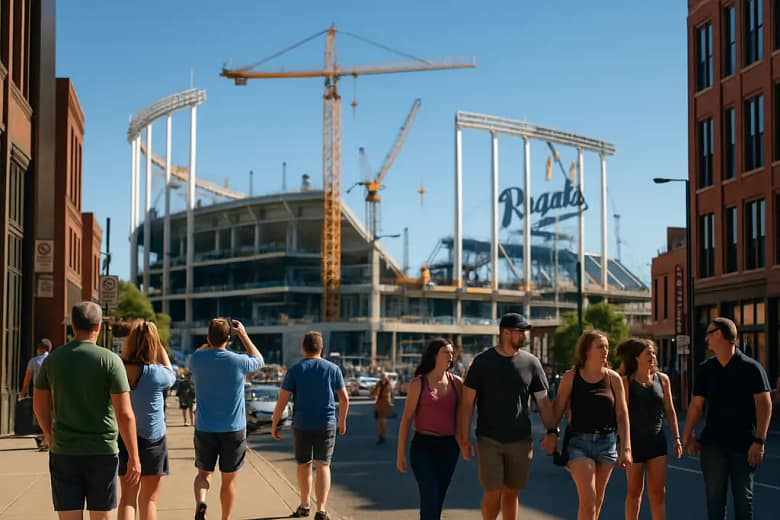
Royals stadium funding became a defining Kansas City sports-business issue in 2026 because the debate moved from concept to approved public action. On April 22, 2026, the Royals, Hallmark, Kansas City Mayor Quinton Lucas, and Missouri Governor Mike Kehoe announced plans for a new ballpark and Baseball District at Crown Center/Washington Square Park, with the project projected to generate 20,000 construction jobs and support 1,000 union jobs on each game day Kansas City announcement.
The sports case starts with baseball. The Royals have framed the downtown plan as a long-term home for the club, team offices, and a surrounding district tied to game-day activity. The public-policy case is harder: Kansas City committed $600 million in public funding to a stadium-and-district plan that also depends on large private investment. That makes the project a test of whether a ballpark can produce measurable civic value beyond the gates.
For baseball readers, the setting matters because stadium projects can reshape how clubs connect to local identity, attendance habits, and downtown routines. An insightful examination of stadium impacts highlights that stadiums are more than just structures. Related baseball coverage across the network, including on Books on Baseball, often reminds us that ballparks are not just buildings; they are public gathering places with long civic memories. The policy question is whether this one can match that cultural value with transparent delivery.
Why Royals Stadium Funding Matters Now
Royals Stadium Funding Moved From Proposal To Policy
The most important shift happened after the April 2026 announcement. On August 20, 2026, the Kansas City Council approved, by an 11–2 vote, a package of ordinances covering stadium funding, agreements, financing, and land rezoning for a downtown stadium planned to open in 2030. That vote did not end debate. It changed the debate from whether Kansas City should pursue the project to how the city should track costs, delivery, and public returns.
The project has been described as a stadium, team office, infrastructure, and district plan. Royals owner John Sherman discussed a full stadium-and-core development cost of $1.9 billion, with another $1 billion in private investment tied to the surrounding mixed-use district, according to MLB.com’s account of the club’s stadium plans MLB report. That scale places the project well beyond a ballpark-only decision.
What The 2030 Target Means For Fans
The Royals have aimed for their first home game in the new downtown stadium during the 2030 MLB season. Demolition of current structures in the Crown Center area was expected to begin in 2027. Those dates give Kansas City several years to test whether public commitments, private construction, transportation planning, and neighborhood access remain aligned.
For fans, the change from Kauffman Stadium to a downtown site would affect more than a commute. It would change pregame routines, parking expectations, transit pressure, and the relationship between baseball and surrounding businesses. None of those effects should be overstated before the facility opens. They should be measured against public promises after construction milestones begin.
Public Money And Private Risk
The $600 Million Commitment Needs Clear Tracking
The city’s $600 million public commitment is central to the public trust issue. Research notes describe about $510 million of that amount as tied to the stadium and related facilities, with about $90 million for infrastructure improvements such as roads, utilities, and streetscape work. That split matters because infrastructure can produce broader civic use, while stadium-specific spending mostly benefits the sports venue and district.
Royals stadium funding also relies on bond financing and tax revenues generated through the district, including mechanisms such as Tax Increment Financing, hotel and motel taxes, and sales in the entertainment area. That structure places performance pressure on the district itself. If revenue comes in below expectations, elected officials and the public will need clear reporting on repayment obligations and any budget exposure.
How Public And Private Shares Are Being Framed
The research record describes a public-private mix in which public sources supply a major share while the Royals and private parties fund the rest. One estimate places the Royals’ private contribution at about $911 million, with public sources at about $540 million toward a defined project cost. The wider stadium-and-district package also includes the reported $1 billion private mixed-use investment. These figures should be read carefully because different totals count different pieces of the project.
That is why Kansas City needs consistent public dashboards. A resident should be able to separate stadium construction, infrastructure, financing costs, private development, and community commitments. A fan should be able to see whether baseball access, jobs, and public improvements are being delivered as stated. For a deeper related discussion of public repayment paths and fan accountability, Back2Tap’s prior analysis of Kansas City’s $600M stadium bet fits the same accountability frame.
Economic Development Tests Around The Ballpark
Jobs Claims Require Time-Based Measurement
The announced projection of 20,000 construction jobs and 1,000 union jobs on each game day is significant. It also needs definitions. Construction job totals can include job-years, short-term positions, and work spread across contractors. Game-day union jobs may depend on the final operating model, number of events, and labor agreements. The most useful public reporting would specify duration, wage standards, residency participation, and whether jobs are new or shifted from other local venues.
For athlete advocates and sports leaders, the labor issue is not separate from the game. Stadium workers shape the fan experience. Security, concessions, cleaning, maintenance, hospitality, and operations staff make live baseball possible. If a stadium project is sold as economic development, those workers should be visible in reporting, not treated as secondary to renderings or ceremonial groundbreakings.
The District Must Prove Net Local Value
A downtown ballpark can concentrate activity around 81 regular-season home dates, plus any postseason games, concerts, or civic events if scheduled. The harder question is whether that activity creates new local spending or redirects dollars from existing Kansas City businesses. The research notes support the claim that a mixed-use district is planned; they do not prove long-term net growth.
That distinction is vital. A Baseball District can help if it strengthens public space, connects to transit and nearby employers, and supports local businesses rather than isolating spending inside a controlled district. It can disappoint if it functions mainly as a game-day island. The correct standard is not whether the project looks active on Opening Day in 2030. The standard is whether downtown benefits persist on non-game days and across multiple budget cycles.
Community Benefits And Sports Identity

Community Investments Need Public Benchmarks
The Royals agreed to contribute $55 million in community investments, including $5 million for the Housing Gateway program, $5 million for the Negro Leagues Baseball Museum, $14 million for One Percent for the Arts, and about $31 million toward youth sports, education, and other public initiatives. Those categories connect baseball to housing, culture, art, and youth development. They also require timelines, recipients, and public reporting.
Royals stadium funding should be judged partly by whether these commitments reach people outside premium seating areas. Youth sports investments can support participation if they reduce real barriers such as field access, equipment cost, transportation, and coaching capacity. Support for the Negro Leagues Baseball Museum carries special local meaning because Kansas City’s baseball identity is tied to that institution and its national significance.
Fan Trust Is Part Of The Development Deal
Sports economics can become abstract, but fan trust is practical. Fans want a competitive team, a fair stadium experience, and confidence that public money is not being used without guardrails. Residents who are not baseball fans still have standing because tax policy and infrastructure spending affect the city as a whole.
The Royals’ move toward Crown Center/Washington Square Park will be evaluated in stages: land preparation, bond issuance, infrastructure work, private development, lease terms, community investment, and the 2030 opening target. Each stage gives Kansas City a chance to publish clear information before frustration builds. Transparency is not a public-relations feature; it is basic risk management.
Royals Stadium Funding Accountability
The Scorecard Should Be Public Before Opening Day
The safest way to assess Royals stadium funding is to use a public scorecard before the first pitch at the planned 2030 ballpark. That scorecard should track public bonds issued, repayment sources, infrastructure spending, construction employment, union game-day staffing, community investment disbursements, and private district delivery. It should also distinguish promised spending from completed spending.
For Kansas City, the project’s value will not be proven by one announcement, one council vote, or one sellout crowd. It will be proven, or weakened, by execution. A new Royals ballpark can serve baseball and local development if the public receives clear evidence that costs, jobs, infrastructure, and community commitments are being delivered as approved. Until then, the responsible position is neither automatic praise nor automatic rejection. It is disciplined oversight rooted in the city’s own promises and the sport’s long-term place in Kansas City civic life.