
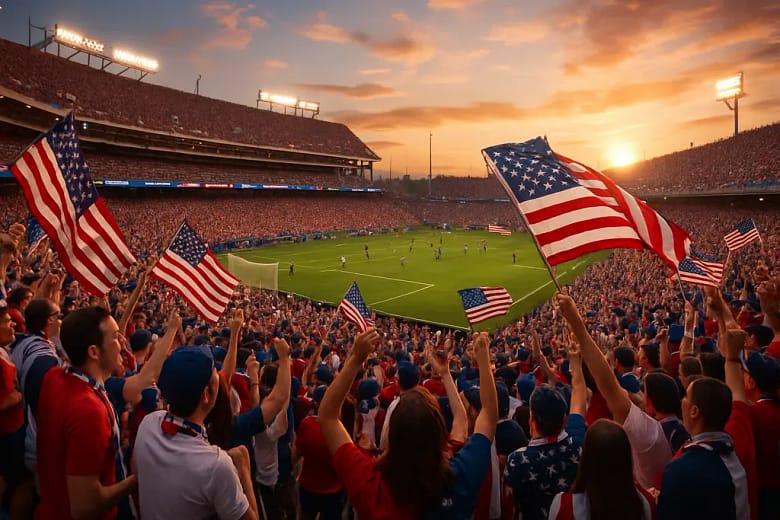
USMNT venue strategy became easier to assess after the Fall 2026 FIFA international window because the full four-match run had already been staged by October 8, 2026. The schedule placed the U.S. Men’s National Team in Orlando, St. Louis, Glendale, and St. Paul between September 26 and October 6, creating a useful case study in how U.S. Soccer balances competitive needs, market access, stadium scale, and fan engagement.
The educational value is clear: venue selection is not only a calendar exercise. It functions like a standards-based planning process. Coaches identify preferred opponents, while federation staff weigh fan access, stadium history, facilities, climate, broadcast needs, and local demand. That mix does not guarantee a result on the field, but it can shape the setting in which a national team prepares, plays, and connects with supporters.
USMNT Venue Strategy In The Fall Window
The Fall 2026 window gave U.S. Soccer four different market profiles in less than two weeks. According to the official U.S. Soccer venue guide, the matches were scheduled for September 26 against Peru in Orlando, September 29 against Chile in St. Louis, October 3 against Mexico in Glendale, and October 6 against Canada in St. Paul. Since those dates had passed by October 8, 2026, the window should be read as a completed scheduling sequence rather than an active preview.
USMNT Venue Strategy As A Standards Case
The selected stadiums showed a wide capacity range. Allianz Field in St. Paul was listed at 19,400 seats, while State Farm Stadium in Glendale holds more than 63,000 and can expand beyond 78,000. That spread matters because venue size affects ticket availability, crowd density, local travel patterns, and atmosphere. A smaller stadium can concentrate demand and produce a tighter match environment. A larger building can serve a broader regional audience, especially for a rivalry match that may draw from multiple states.
Orlando also carried a performance-history factor. U.S. Soccer noted that the USMNT had a 7-0-0 record at Inter&Co Stadium since first playing there in 2017. The careful reading is not that venue history predicts future results. It does, however, explain why federations track past performance, supporter response, and operational familiarity. If a site has supported positive team experiences before, it can remain in the pool for future consideration.
- September 26, 2026: Peru in Orlando, Florida.
- September 29, 2026: Chile in St. Louis, Missouri.
- October 3, 2026: Mexico in Glendale, Arizona.
- October 6, 2026: Canada in St. Paul, Minnesota.
How Venue Criteria Shape Fan Access
Public discussion often begins with the opponent, but federation planning has to account for the building around the match. ESPN reported that climate, fan base density, hotel and training infrastructure, and broadcast logistics are part of the selection process, with larger venues fitting some high-demand opponents and smaller soccer markets fitting other matchups in different demand conditions, according to an ESPN venue process report.
Capacity And Demand Signals
Stadium capacity is one of the clearest fan-facing choices. Glendale’s State Farm Stadium offered a different proposition than Allianz Field in St. Paul. Neither model is automatically better. The larger venue can broaden access for families, traveling supporters, and fans who may not often get a national team match nearby. The smaller venue can reward a market with a strong soccer identity and create a sharper in-stadium sound profile.
This is where USMNT venue strategy crosses into education and standards. A transparent framework helps supporters understand why a match may land in a 19,400-seat soccer stadium rather than a much larger NFL venue, or why a rivalry may be placed in a stadium with far greater expansion capacity. The best fan engagement campaigns do not simply announce a venue; they explain why the market, the opponent, and the match objective fit together.
Geography As A Fan Engagement Tool
The Fall 2026 sequence also spread access across several regions: the Southeast, Midwest, Southwest, and Upper Midwest. That matters because national-team fandom is not located in one city. When matches rotate across regions, supporters who cannot travel long distances still have periodic access to the team. This is a practical equity issue in sports engagement, not a slogan.
There is a cross-sport lesson here as well. Local sports participation often depends on place, routine, and access, whether the setting is a national-team soccer match or a community course covered by a related network site such as Copeland Hills Golf. For federations, the standard is higher because a national team carries a public-facing identity. Reaching multiple regions helps make that identity visible beyond the biggest media markets.
Why Stadium History Still Matters
Stadium history can support fan confidence without becoming a prediction model. Orlando’s unbeaten USMNT record at Inter&Co Stadium, as reported by U.S. Soccer, is a useful example. Fans may remember prior nights in that venue, and local organizers can build campaigns around returning to a place with established national-team memory. Still, responsible analysis avoids claiming that the building itself produces wins.
Ritual Without Overstatement
Supporters respond to patterns. A stadium that has hosted the team several times can become part of a fan ritual: familiar gates, familiar supporters’ sections, familiar pre-match routes, and known travel options. These details are not as dramatic as a goal or a roster decision, but they affect whether fans return. Venue selection can therefore support loyalty by reducing friction and increasing familiarity.
The same principle applies in new or less frequent markets. A match in St. Louis or St. Paul can serve as a benchmark for future planning if attendance, operations, atmosphere, and player-support conditions meet federation needs. USMNT venue strategy works best when it uses past evidence but remains open to markets that can prove demand through strong turnout and match-day execution.
Operational Planning Beyond The Ticket

Fan engagement is visible in the stands, but many venue decisions begin away from the camera. Hotel capacity, training fields, transportation, weather, and broadcast setup can affect the experience for players, staff, media, and supporters. If those pieces fail, even a strong crowd may not produce a strong event standard.
Training, Climate, And Broadcast Fit
Climate is a practical factor, especially in windows with tight recovery periods. The Fall 2026 run required moving from Orlando to St. Louis, then Glendale, then St. Paul in an 11-day span. The research notes do not provide team travel details or training schedules, so any claim about fatigue or preparation would be unsupported. What can be said is narrower: U.S. Soccer’s venue process includes climate and infrastructure as formal considerations, and those considerations are relevant when multiple matches are grouped in a short FIFA window.
Broadcast logistics also matter for fan engagement because many supporters experience national-team matches remotely. A venue that works well for television and streaming access can widen the audience beyond the stadium. That does not reduce the value of the live crowd. It means the venue must serve both the supporters in the seats and the supporters following from other regions.
The November Match As The Next Test
The next confirmed USMNT match after the October 6 game against Canada was a CONCACAF Nations League Quarterfinal on November 18, 2026, at TQL Stadium in Cincinnati, Ohio, according to the research notes. That selection continued the pattern of regional reach beyond only the largest national markets. Cincinnati also gives planners another data point in a soccer-specific environment, where match-day atmosphere and operational performance can be judged against the standards used in the Fall 2026 window.
USMNT Venue Strategy After The Fall Window
USMNT venue strategy after the Fall 2026 window should be evaluated through evidence rather than assumptions. The completed four-match run showed geographic spread, capacity variation, attention to prior venue history, and a planning model that weighs both competitive and commercial realities. Those are measurable categories, even when some internal federation calculations remain private.
What Fans Can Reasonably Track
Supporters and analysts can track several public indicators without overstating what is known: where matches are placed, how stadium size compares with the opponent, whether a market has prior national-team history, and how the federation explains the choice. They can also watch whether future matches continue to mix large-capacity venues with soccer-specific stadiums.
For education-focused sports coverage, the key standard is clarity. Venue planning should be discussed as a structured decision process involving access, facilities, climate, broadcast needs, opponent demand, and local soccer culture. That frame gives fans a better way to judge decisions and gives U.S. Soccer a clearer path to build trust. If the federation keeps explaining why certain cities and stadiums fit certain matches, USMNT venue strategy can become more than a scheduling topic. It can become a fan-engagement practice grounded in visible criteria.