
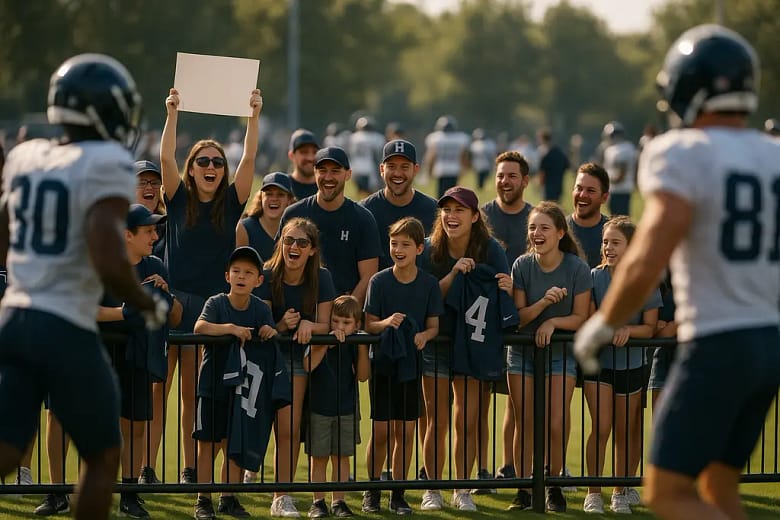
open training camps give NFL teams a rare setting where fan access, player preparation, community identity, and local sports business meet in one place. For the Denver Broncos and Kansas City Chiefs, the attendance records and access changes cited in the research show that training camp is not just a preseason football function. It is also a public-facing test of how teams keep supporters close while protecting football operations.
The strongest evidence comes from Denver, where attendance data is available through CBS Colorado and the team. In 2015, the Broncos drew 54,313 fans across 13 practices, an average of 4,178 per session, with a single-day high of 5,507 fans on August 7, according to CBS Colorado. Two years later, the Broncos reported 54,013 fans across 11 practices, an average of 4,910 per session, with a single-day mark of 7,085 fans on August 5, according to the team report.
The Chiefs case adds a useful comparison. The research records 60,000 fans over three weeks at Missouri Western State University in 2010, then more than 62,000 fans in 2019. It also notes two later adjustments: a 2020 practice at Arrowhead Stadium limited to about 2,000 season-ticket members during the COVID-19 period, and a 2025 camp structure at Missouri Western that used advance tickets with both free and paid sessions. Those shifts matter because fan engagement is not measured only by peak attendance. It is also measured by how teams manage access under pressure.
Open Training Camps As A Fan Access Test
The first value of camp access is simple: it lets supporters see football work before the regular season begins. That access has a different feel from a game day. Fans watch individual drills, position groups, roster competition, special teams periods, and coaching routines in a setting where the scoreboard is not the main filter. For younger fans, that can be the first clear view of how professional players train. For long-time supporters, it can strengthen their connection to roster development and coaching decisions.
What Open Training Camps Measure
Attendance totals measure demand, but averages may tell a sharper story. Denver’s 2017 average of 4,910 fans over 11 practices was higher than the 2015 average of 4,178 over 13 practices. The total crowd was slightly lower in 2017 than in 2015, but the per-practice draw was stronger. That distinction matters for teams because operating plans are built around daily crowd flow, parking, staffing, security, seating, and heat management rather than season totals alone.
For the Broncos, open training camps created a large public touchpoint during a period that is usually dominated by roster installation and preparation. For the Chiefs, the move to Missouri Western in 2010 gave St. Joseph a repeat summer sports event tied to one of the NFL’s most visible regional fan bases. The research indicates that crowd size rose from 60,000 in 2010 to more than 62,000 in 2019. That does not prove every part of fan loyalty was caused by camp access, but it does show that public practices can draw sustained interest when the setting is consistent and fans understand the process.
Access Is Not The Same As Unlimited Capacity
Access also has limits. The Broncos’ 2025 camp, as described in the research, was set to allow about 800 fans per practice across 13 open sessions because of construction at Broncos Park Powered by CommonSpirit. That is a sharp change from the crowd sizes recorded in 2015 and 2017. The important lesson is not that one model is better in every year. It is that teams must adjust the fan experience around facility constraints while keeping public access credible.
For sports leadership, that is an athlete-rights issue as much as a fan-service issue. Players need safe, workable training conditions. Coaches need enough control to teach and evaluate. Fans deserve clear information before they commit time, travel, and money. A sustainable camp model respects all three groups instead of treating access as a promotional extra.
Broncos Data Shows Demand And Constraint
Denver offers the clearest numerical case in the available research. The 2015 total of 54,313 fans across 13 practices and the 2017 total of 54,013 across 11 practices are close in total size, but the structure changed. Fewer practices in 2017 produced a higher per-practice average. From an operations viewpoint, that can increase pressure on entry lines, seating areas, concession planning, staff assignments, and shaded spaces.
Why Per-Practice Attendance Matters
Per-practice attendance is a better planning tool than a headline total. A team can draw 50,000-plus fans across camp and still face very different conditions depending on how those fans are distributed. A steady pattern of 4,000 to 5,000 people requires one type of plan. A single-day high above 7,000 creates a different demand on the host site. Denver’s 7,085 single-day attendance figure in 2017 shows how fast a practice can become a major public event.
That scale creates responsibility. Teams should be clear about parking, arrival windows, weather policies, security rules, water access, autograph procedures, and accessibility. Those details are not separate from fan engagement. They shape whether families, older supporters, and fans with disabilities can participate without unnecessary strain. Good fan engagement is not only emotional; it is practical.
What The 2025 Limit Signals
The reported 2025 limit of about 800 fans per practice reflects a different kind of planning problem. A smaller crowd can protect construction logistics and practice flow, but it can also create scarcity. That makes ticket communication and distribution standards more important. If supporters know the reason for the limit and understand how to obtain access, the team can preserve trust even while serving fewer people on site.
For teams, open training camps work best when expectations match capacity. Overpromising access can frustrate fans. Overrestricting it can weaken community connection. The balance should be transparent, with special attention to families and local supporters who use camp as their most affordable path to see the team in person.
The Chiefs Case In St. Joseph
The Chiefs’ camp presence at Missouri Western State University shows how a team can turn preseason preparation into a regional sports event. The research cites 60,000 fans in 2010 over three weeks and more than 62,000 in 2019. Those figures indicate strong public interest in a college-campus camp setting. They also point to the sports-tourism value of hosting practices outside the team’s usual stadium environment.
Community Value Beyond The Practice Field
Training camp can bring visitors into a host community for food, lodging, fuel, and local retail. The research identifies St. Joseph as a community that can benefit from Chiefs camp activity. The exact economic value is not provided in the available material, so it would be unsafe to attach a dollar figure. Still, the basic mechanism is clear: when tens of thousands of fans travel to a camp site across multiple weeks, the host community has a chance to capture spending tied to the event.
That community link also carries a civic function. Local children can see professional athletes up close. Fans who may not attend regular-season games can still participate in team culture. For readers interested in how community coverage connects sports, civic life, and local identity, check out a related site in the same network.
How Restricted Access Changes Engagement
The Chiefs’ 2020 practice at Arrowhead Stadium, limited to about 2,000 season-ticket members with health protocols in place, illustrates how teams adapted during a public health crisis. The research does not support broad claims about fan satisfaction from that event, so the safer reading is narrower: the team maintained some in-person access while using limits. That matters because complete closure and limited access produce different relationships with fans.
The 2025 model described in the research, with advance tickets and both free and paid sessions, raises another engagement question. Ticketing can help manage crowd flow and set expectations. Paid sessions may support operations, but teams should be careful that pricing does not cut off the families and local supporters who give camp its community value. A fan-first model should keep some accessible entry points intact.
Engagement Lessons For NFL Teams

Across the Broncos and Chiefs examples, the main lesson is that open training camps are both football events and community systems. They create direct contact between a team and its supporters, but they also require choices about space, safety, staffing, and fairness. The best measure is not just how many fans attend. It is whether the team creates a repeatable setting that respects players, coaches, workers, and supporters.
Indicators Teams Should Track
Attendance records help, but they should not stand alone. Teams can learn more by tracking patterns that connect fan demand with real operations.
- Average attendance per practice, not only total camp attendance.
- Single-day crowd peaks that affect staffing, parking, and safety plans.
- Share of free access compared with paid or restricted sessions.
- Capacity limits caused by construction, health protocols, or site design.
- Community participation from families, youth groups, and local residents.
These indicators matter because they tie engagement to lived experience. A camp that draws a large crowd but leaves fans confused or overheated has not met the standard. A smaller camp with clear access, safe conditions, and fair distribution can still build trust.
Why Sustainable Access Matters
Sustainable practice access should not mean maximum crowd size every year. It should mean a model that can survive changes in facility conditions, health rules, and team needs. The Broncos’ construction-related limit and the Chiefs’ health-protocol adjustment show that access can change quickly. Teams that explain those changes clearly are better positioned to keep credibility with supporters.
This is where fan engagement meets athlete welfare. Public practices should never compromise player preparation or safety. They should also avoid treating fans as an afterthought once tickets are distributed. The responsible middle is a camp plan that sets realistic capacity, protects the practice environment, and gives fans enough information to plan their day.
What Broncos And Chiefs Camps Show About Fan Access
The strongest case for open training camps is not that every practice must be open or that every team should chase attendance records. The case is that public access can deepen the relationship between teams and communities when it is planned with care. Denver’s records show measurable demand. Kansas City’s St. Joseph numbers show how a camp can become a regional event. The later limits in Denver and Kansas City show that engagement has to adapt when conditions change.
For NFL teams, the next standard should be clear: publish reliable camp information, preserve affordable access where possible, protect player working conditions, and measure success beyond crowd size. Training camp is where football preparation begins, but for many supporters it is also where the season first feels real. That makes access worth protecting, especially when the plan is honest about capacity and respectful of everyone at the field.