
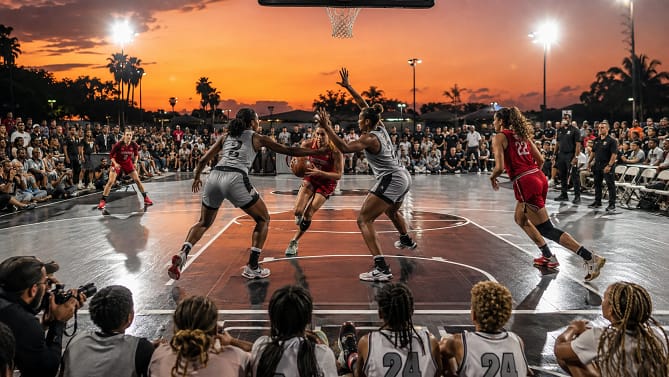
Recreational 3×3 basketball offers adults a straightforward starting point: a small team, one basket and a clear competitive format. The participation side was visible at the 2026 FIBA 3×3 World Cup in Warsaw, where the international tournament ran alongside amateur, university and district events. FIBA reported approximately 1,500 participants across its side tournaments and community activities. That matters for local basketball: watching the sport and finding somewhere to play can be part of the same event.
For readers interested in recreational sports, the useful question is how to turn that interest into a weekly commitment. A shorter roster can make organizing a team more manageable, but a smaller court does not automatically produce an easier game. The strongest adult programs need suitable divisions, dependable court access and enough explanation for newcomers to participate confidently.
Smaller Rosters Make Organizing More Manageable
FIBA’s 3×3 basketball format uses three players on court and one substitute per team. Games take place on a half-court with one basket. Those requirements give a group of four adults a defined route into organized competition without assembling a full five-on-five roster.
The organizational advantage is straightforward. There are fewer individual schedules to coordinate and fewer positions to fill before a team can enter. For an organizer working with limited court availability, half-court play creates options that a full-court competition does not offer.
Small rosters still need reliable attendance. A four-player team losing one member has no substitute available; losing two leaves it without the three players required to start an official game. The practical response is to confirm availability before registration, check the organizer’s roster-change policy and avoid assuming a replacement can arrive unannounced.
For informal sessions, keep a wider contact group rather than relying on exactly six people attending every week. A tournament roster and the group that shares practice time do not need to be identical.
Ten Minutes of Game Time Is Not a Ten-Minute Booking
Under the official format, regulation lasts 10 minutes, with a team winning early if it reaches 21 points before regulation ends. Possessions have a 12-second shot clock. FIBA’s rules explain that the game clock stops during dead-ball situations; a tie leads to overtime, won by the first team to score two points.
Those details matter for recreational scheduling. Ten minutes describes the playing clock, not the complete time required to bring teams onto court, manage stoppages, record a result and prepare the next fixture. A facility booking built from back-to-back ten-minute slots would leave no allowance for those tasks.
Organizers should publish both the playing format and the expected attendance window. Players need to know whether their commitment involves one game, several pool games or a longer tournament session.
A social group can choose an adapted format, but it should state the changes before play begins. A running clock or different scoring target is a local variation, not the standard official format. Clear communication prevents two teams from arriving with different expectations.
Choose the Division Before Chasing the Tournament
A recreational label does not tell a player everything about the opposition. Before entering, ask how the organizer separates experience levels, whether teams can change divisions after an initial assessment, and how individual players without teammates are accommodated.
The FIBA Open in Mies provides a useful example of participation organized around different groups. Its published program includes over-40, wheelchair, Special Olympics, family and corporate categories. These are distinct categories, not a single competition expected to suit every participant.
For a local adult league, that suggests a practical principle: describe the intended player before promoting the event. A returning player seeking structured social games may have different expectations from someone entering an advanced open tournament.
Age categories alone do not settle the skill question. An organizer should explain the expected competitive standard and the rules used in each division. A newcomer should be able to find those answers before paying an entry fee, rather than discovering the mismatch during the opening possession.
Practice Decisions, Not Just Uncontested Shots
The transition from conventional basketball to 3×3 deserves attention. In a June 30, 2026 profile, USA Basketball described Dani Carnegie’s 3×3 adjustment after her first experience with the format at a development camp in Phoenix the previous month. The report highlighted her adjustment to the continuous play and different rules.
That example offers a useful reminder for recreational players: previous basketball experience does not remove the need to learn a different format. Use a practice session to rehearse the actual situations the team expects to face, rather than treating every meeting as a shooting contest.
A simple starting exercise is to agree on the first action after a check-ball, then play the possession against defenders. Review whether the ball-handler had a passing option and whether teammates created space or crowded the same area. Change one decision and repeat the sequence.
Set one shared objective for the session, such as communicating defensive assignments or making the next pass available. This gives a team something specific to evaluate beyond whether its shots happened to fall that evening.
Use Online Research to Solve the Right Problem
Digital sports resources serve different purposes. BookmakersReview betting app ratings concern betting-platform comparisons, not recreational league eligibility or coaching. For a team preparing to play, the relevant information comes from the organizer’s registration details, competition rules and confirmed schedule.
FIBA’s event-search guidance describes filters for country, nearby city and organizer. Its support pages distinguish recreational events from professional circuits. That provides a starting point for finding organized opportunities, not a guarantee that every local game will appear in the directory.
Contact the organizer to confirm the division, venue, entry deadline, roster requirements and number of games included. Ask what happens if an outdoor event cannot proceed and whether a replacement date is available. These are registration questions, not details to leave until match day.
For the team itself, a shared calendar and one reliable contact person may be more useful than another app. Keep the confirmed schedule easy to find, separate it from casual group-chat discussion and record changes in one place.
Judge the First Month by Repeat Participation
For a new recreational 3×3 basketball group, a useful first-month review should extend beyond wins and losses. Did the same players return? Were games reasonably matched? Did everyone know the format, and did the session finish close to the advertised time?
Treat these as practical checks rather than formal performance statistics. If players regularly arrive late, review the booking time. If one team consistently overwhelms the others, revisit division placement. If rule disputes interrupt sessions, schedule an explanation before the next round instead of repeatedly stopping games to debate the same issue.
Keep the next step modest. A dependable weekly session is a stronger foundation than an ambitious tournament calendar that the group cannot maintain. Before adding more fixtures, establish that the existing arrangement works for the people attending.
The opportunity for adult 3×3 is to turn a compact competitive format into repeat participation. The best evidence for an individual program is simple: players know when they are playing, understand what they are entering and choose to come back.