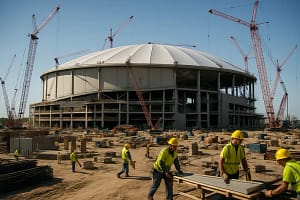

Royals Stadium Funding has moved from a stadium wish list into a defined civic finance test for Kansas City. The planned downtown ballpark and surrounding district carry a reported total estimated cost of $2.05 billion, with $1.14 billion from public funds and $911 million from private sources. For baseball, this is not only a venue story. It is a question of how a city values a major-league club, how much risk it accepts to keep that club anchored downtown, and how clearly fans and residents can track the public return.
The plan had already passed major local steps by September 23, 2026. On April 16, 2026, the Kansas City Council passed Ordinance 260339, authorizing negotiations with the Royals for a stadium near Washington Square Park and Crown Center, according to the city’s official release. On August 20, 2026, the full Council passed Ordinance 260704, authorizing lease, development, funding, and community impact partnership agreements.
The projected schedule remained clear but not yet completed as of September 23, 2026: the ballpark was expected to break ground in 2027 and targeted to open in time for the 2030 MLB season, as described in MLB’s report on the Royals-Hallmark plan. That timeline matters because public obligations, private investment, community benefits, and construction disruption all sit on different clocks.
How Royals Stadium Funding Is Structured
Kansas City’s commitment is reported at $600 million. That includes $510 million in city-backed bonds and $90 million in infrastructure contributions. The larger public share of the project is reported at $1.14 billion, but the state role remained unresolved in the research record. Missouri’s potential contribution under the Show-Me Sports Investment Act was still unclear because the city had not yet submitted its application several weeks after the project announcement.
City Bonds And Infrastructure Commitments
The city-backed bond figure is the central public-risk number. Bonds can give a stadium project early funding certainty, but repayment stretches the cost across years of public budgets. The reported plan requires the city to pay off $510 million in bonds over 30 years. If tax increment financing falls short, the city’s general fund may be used to cover bond payments. That is the part of the agreement fans should read with the same care they bring to a box score: the headline cost is large, but the repayment path defines the pressure point.
A related analysis of Kansas City’s $600M commitment explains why bond repayment, lease terms, and public revenue assumptions need to be evaluated together rather than treated as separate talking points.
Why Royals Stadium Funding Depends On District Taxes
Royals Stadium Funding relies on several public mechanisms tied to the ballpark district and city tax streams. The research record describes a 23-year mechanism using half of incremental sales and earnings taxes generated inside the ballpark district. It also describes a 30-year structure involving several city taxes plus a newly proposed sales tax of up to 1%.
That structure has a sports-business logic: a downtown district is expected to generate activity around games, events, restaurants, and related development. But the public question is whether that activity is new enough, durable enough, and properly measured. A stadium district can move spending from one part of a region to another. It can also create new event-day concentration. The difference matters to residents because only measurable revenue can pay debt, fund services, and justify long commitments.
Economic Claims And Public Exposure
The employment projections give supporters a clear talking point. The project is expected to generate about 16,000 construction job-years, where one job-year means one job for one year. It is also expected to support about 2,275 permanent jobs, which is reported as an increase of 200 from existing employment in the area. Those are meaningful figures, but they should be read precisely. Construction job-years are not the same as 16,000 permanent jobs. Permanent job projections also need later comparison against actual hiring, wages, and job retention.
Job Counts Need Clear Scorekeeping
Sports leaders should welcome transparent scorekeeping here. A city that publicly reports construction hiring, permanent jobs, and community spending by date and category can help residents see whether projections are being met. From an athlete-rights and community-accountability point of view, the labor story should not stop at a project total. The public interest is better served when job access, workplace standards, youth sports investment, and neighborhood effects are all visible.
The Royals’ reported community investment package is $55 million. The research record identifies $5 million for the Housing Gateway Program, $5 million for the Negro Leagues Baseball Museum, $14 million for the One Percent for the Arts Program, and the remainder directed toward youth sports, education, and park improvements. For those interested in broader baseball culture, further context can be found at Books on Baseball.
Public Risk Is Not Just A Finance Term
Public risk has a human side. If bond payments place pressure on the general fund because revenue falls short, the debate moves from a stadium ledger into city services. That does not mean the project will fail; the research does not support that claim. It means the public deserves clear reporting on revenue performance, bond repayment, and any general-fund exposure across the 30-year period.
The political record also shows why public confidence cannot be assumed. In April 2024, Jackson County voters rejected a 40-year, 3/8-cent sales tax proposal tied to a Royals stadium and Chiefs/Arrowhead upgrades. That vote signaled resistance to new tax measures. The 2026 city plan used a different route, but the prior vote remains relevant because it shows that many residents wanted a higher bar for public stadium spending.
What Fans Should Track Before 2030

The 2030 target gives Kansas City several years to test whether promised public benefits become documented outcomes. For fans, the stadium experience will eventually be judged by transit access, ticket affordability, game-day flow, neighborhood fit, and the quality of the ballpark itself. For residents, the test is broader: repayment discipline, clear reporting, enforceable community benefits, and honest updates when assumptions change.
Lease, Development, And Community Agreements
The August 20, 2026 Council action authorized lease, development, funding, and community impact partnership agreements. Those documents matter because they turn political support into operating rules. A strong agreement should answer practical questions: who maintains what, who receives which revenues, how community investments are timed, and what happens if costs or revenues differ from projections. The research record confirms the authorization, but the public value will depend on the terms that govern the deal during construction and after opening.
Royals Stadium Funding is also a test of industry leadership in baseball. Stadiums are often promoted through civic pride and team loyalty. Those emotions are real, and they are part of why sports matter. Still, public money demands public proof. Kansas City’s baseball supporters can want a modern downtown ballpark and still ask for disciplined financial disclosure. Those positions are not in conflict.
Royals Stadium Funding Accountability
The key accountability question is not whether downtown baseball sounds appealing. The question is whether the city, club, and project partners can show that the public share is being managed with care across decades. That starts with the $510 million bond obligation, the $90 million infrastructure contribution, the district-tax mechanisms, and the unresolved state-funding piece.
By September 23, 2026, the plan had defined its broad cost, public-private split, local legislative path, projected jobs, community investments, and target timeline. It had not removed every uncertainty. The clearest path for trust is regular public reporting that compares actual revenue, spending, jobs, and community commitments against the figures used to approve the deal. If Royals Stadium Funding becomes a model for sports finance, it will be because Kansas City treated fans and residents as stakeholders, not spectators in a deal already written for them.