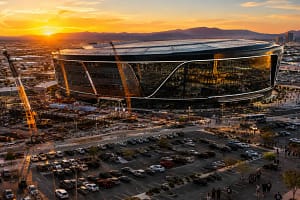
Allegiant Stadium upgrades approved on September 2, 2026, put Las Vegas in a familiar sports-business position: the city is investing before a global football event while asking how much public value the work can return. Super Bowl LXIII is scheduled for February 2029, so the timing gives the Raiders, the Las Vegas Stadium Authority, and regional tourism leaders a fixed deadline rather than an open-ended venue wish list.
The north entrance plan is not about adding a new team, chasing a larger seating bowl, or replacing a young building. Allegiant Stadium opened in 2020, and the current project focuses on the side of the venue that carries heavy game-day pressure from the Las Vegas Strip. That makes the economic question more specific: can access, pedestrian space, event decks, and transportation changes improve the performance of a stadium that has already become a major Las Vegas sports asset?
Why Allegiant Stadium Upgrades Matter Before 2029
The Las Vegas Stadium Authority unanimously approved $75 million in public funds toward a $158 million north entrance renovation on September 2, 2026, with the Raiders financing the remaining $83 million according to the Raiders. The approved scope includes a new plaza, elevated pedestrian and event decks, a canopy, and transportation improvements. Those are venue operations investments first, even if the Super Bowl date gives the project a national frame.
Allegiant Stadium Upgrades And The North Entrance
The north entrance matters because it serves the stadium’s busiest side, especially traffic coming from the Las Vegas Strip by way of Hacienda Bridge. The work is slated to begin in the third quarter of 2027 and finish by late 2028. That schedule is designed to have the project in place before Super Bowl LXIII in February 2029, but the value test extends beyond one week of NFL programming.
For football, stadium access is part of the live product. Fans judge arrival, line flow, weather exposure, and postgame movement alongside the score and the in-bowl experience. A north-side plaza and elevated decks could create more usable space before and after games, though the final effect should be judged after the work is built and tested across Raiders games, concerts, and neutral-site events.
Game-Day Flow From The Strip
Las Vegas is unusual because a major NFL stadium sits close to a tourism corridor with dense hotel inventory. That proximity is a strength, but it also concentrates movement around pedestrian routes and ride patterns. The planned transportation improvements are therefore not a cosmetic add-on. They sit at the center of how the building handles large event-day crowds.
There is still uncertainty. Approval of funding does not prove that every queue will shorten or that every guest will experience easier entry. Construction delivery, event scheduling, staffing plans, and coordination with local transportation systems will shape the actual result. The strongest case for the project is that the work targets a clear operational pressure point rather than a vague desire for newer amenities.
Funding Model And Economic Exposure
Allegiant Stadium was built at an approximate cost of $2 billion and has a seating capacity around 65,000 to 71,000; the original public stadium investment included $750 million from public funds, notably through hotel room taxes, and the north entrance public share is set to use surplus room-tax revenue from the Waterfall Residual Fund as reported by NFL.com. Those details explain why the funding model deserves scrutiny even when the stadium is producing high-profile events.
Public Dollars And Raiders Funding
The split between $75 million in public money and $83 million from the Raiders is central to evaluating the project. Public contributions to sports venues are often defended through tourism, jobs, and tax activity, but those claims should be tested against costs, opportunity trade-offs, and public access benefits. That standard applies here, too, because the same building serves private team interests, visiting fans, concert promoters, tourism operators, and local workers.
For readers comparing this project with other venue deals, Back2Tap’s analysis of public stadium spending offers a useful parallel: stadium upgrades should be judged through seats, prices, labor, public cost, and verified public gains, not only ribbon-cutting value. The same caution fits Las Vegas because a public financing stream tied to hotel rooms does not remove the need for clear reporting.
What The Existing Stadium Record Shows
The research record supplied for this analysis shows that Allegiant Stadium has hosted more than 151 major ticketed events since opening, drawn more than 7 million attendees, and generated $10.6 billion in economic activity through those events. Those figures support the argument that the building has become a high-use venue, not a single-purpose NFL site.
The same research notes show that trailing 12-month totals through Q3 2025 put stadium-linked regional output at $2.4 billion, compared with earlier projections of $620 million. Employment connected with the stadium was listed at 10,600 jobs versus projections near 5,980 jobs, and wages and salaries tied to stadium-related activity were listed at $587 million versus a predicted $230 million. These are significant figures, but they should be read as economic activity measures, not automatic proof of net fiscal gain for every public dollar spent.
Super Bowl LXIII Stakes For Las Vegas
Super Bowl LXIII in February 2029 gives the project a clear performance date. The Super Bowl is not a standard home game. It brings league operations, media, corporate hospitality, sponsor activity, visiting fans, and public safety demands into one compressed period. Stadium access improvements can matter in that setting, especially at an entrance tied to the Strip-facing side of the venue.
The 2024 Benchmark
The research notes point to Super Bowl LVIII in February 2024 at Allegiant Stadium as the closest local benchmark. That event brought more than 330,000 visitors to Las Vegas and generated more than $1 billion in total economic impact for the region. Those figures help explain why local officials would want the stadium’s north entrance ready before the 2029 game.
Still, the 2024 benchmark should not be treated as a guaranteed 2029 result. Economic impact depends on visitor volume, hotel demand, event programming, pricing, local spending patterns, and how much activity would have happened in Las Vegas without the game. A cautious reading is better for public trust: the prior Super Bowl shows capacity for major impact, while the 2029 event will need its own post-event accounting.
Venue Readiness, Not Just Aesthetic Spend
From a sports-first view, the strongest argument for the north entrance work is readiness. The project targets circulation, gathering space, and transportation movement. Those factors affect fans before kickoff and after the final whistle, and they shape how a venue handles the pressure of national events.
There is also a competitive positioning element. Las Vegas has used Allegiant Stadium for NFL games, college football, concerts, and major event programming. If the venue can move crowds more effectively on its busiest side, that could support future bids and recurring events. That statement should remain conditional until the project is completed and measured against event-day data.
Risk Controls For Sports-First Public Value

Public approval should not end the accountability process. A stadium project with public funds needs clear milestones before construction, during work, and after opening. That is especially true for a building that already has a strong event record, because new spending should solve a defined problem rather than rely on the venue’s past success.
Questions Leaders Should Keep Public
The useful questions are practical. Did construction begin in the third quarter of 2027 as planned? Was the work completed by late 2028? Did the final cost remain near the approved $158 million plan? Did the north entrance reduce pressure on the busiest side of the stadium during Raiders games and major events? Did the project improve movement from the Strip via Hacienda Bridge?
- Publish construction milestones and explain any schedule changes before February 2029.
- Separate Super Bowl-week effects from regular Raiders games and other stadium events.
- Report how surplus room-tax funds were used and whether public exposure changed.
- Track fan access indicators tied to the north entrance, not only regional spending totals.
Where Cross-Sport Lessons Fit
Football stadium economics can learn from arena markets, where event frequency, premium spaces, and downtown movement often shape public debate. For those interested in comparing economic impacts across sports, NBA Playbook offers insights into the business dynamics of basketball venues. The lesson is not that every venue model is the same; it is that public-value claims become stronger when they are tied to measured fan experience and transparent financial reporting.
Allegiant Stadium Upgrades And Public Value
The Allegiant Stadium upgrades carry a defensible sports rationale because they focus on access at the stadium’s busiest side before a scheduled Super Bowl. The funding split also gives the public a clear number to track: $75 million from public funds and $83 million from the Raiders for a $158 million project.
The public-value case will be strongest if Las Vegas treats February 2029 as a checkpoint, not the only measure of success. Super Bowl LXIII will bring global attention, but Raiders games and other ticketed events will show whether the north entrance work improves the stadium on ordinary high-demand days. That is the standard that best serves fans, workers, taxpayers, and the teams and events that rely on Allegiant Stadium.