The story of para sport didn’t start in a boardroom. It began on a British hospital’s playing fields in the 1940s. Sir Ludwig Guttmann, a neurosurgeon, used sports like archery and basketball to help patients with spinal injuries.
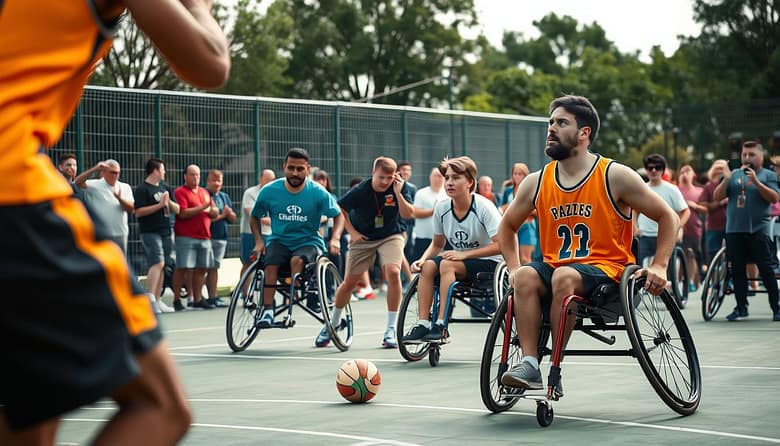
This was more than just a game. It was a way to fight against the odds. In the United States, Professor Tim Nugent was doing the same thing at the University of Illinois. He turned wheelchair basketball into a symbol of freedom and self-reliance.
By 1948, the para sport world had grown a lot. It started with the Stoke Mandeville Games for wheelchair veterans. Now, it’s the Paralympics, a global event with many sports.
Every sport choice is a bold statement. For example, picking wheelchair rugby over seated volleyball shows a preference for action and strength. It’s not just about skill; it’s about attitude and physicality.
The shift from therapy to competition raises important questions. Are we creating programs that just include people, or do we aim to challenge our views of athleticism? With thousands involved, we’re not just adapting sports. We’re creating new kinds of athletes.
For more on this, check out the research that’s changing the game. It shows how policy and practice are evolving together.
So, what’s next? Are we just adding people to existing sports, or are we making new ones? Ones that make us rethink what an athlete is.
Accessibility Standards and Volunteer Roles
Accessibility is more than just building ramps. It’s about creating a welcoming space for everyone. In the 1970s, Hal O’Leary fought for mono-skiers to enjoy the mountains. Today, we need to focus on the human side of inclusion, not just checklists.
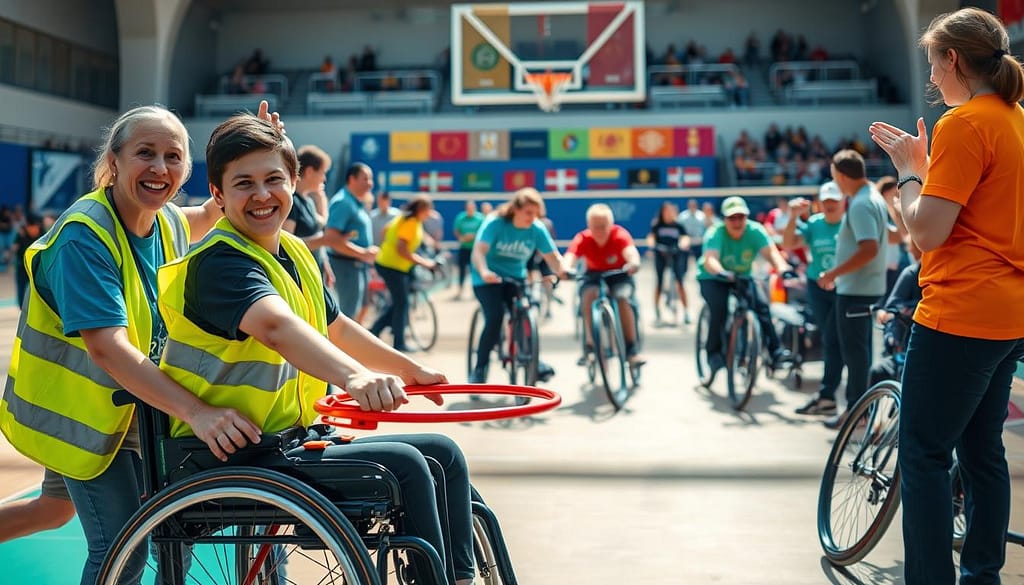
Building a community of volunteers is key. A 2024 study found that volunteers who feel proud of their work and grow personally do better. Things like certificates don’t make a difference.
| What Works (Internal & Relational) | What Doesn’t (External Rewards) |
|---|---|
| Attachment to the Organization: Pride in the mission and community. | Certificates & Swag: External recognition or free merchandise. |
| Volunteer Attachment: Bonding with fellow volunteers and athletes. | Networking for Resume: Building a CV or professional contacts. |
| Internal Benefits: Personal growth, purpose, and a sense of accomplishment. | Mandatory Credit: Service hours for school or work requirements. |
Building a ramp is easy. But creating a welcoming community is hard. An inclusion day succeeds when volunteers are part of the mission, not just helpers.
The best accessibility standard is a volunteer who cares. They remember athletes’ names and personal bests. They make events more than just events; they create a community where everyone belongs.
Equipment, Safety, and Insurance
Forget the myth of the superhuman athlete; in adaptive sport, the first competition is between engineers, not athletes. The real race starts in the lab, long before the starting pistol fires. The line between human and machine blurs into a single, high-performance system. The adaptive equipment isn’t just a tool; it’s a biomechanical extension of the athlete, engineered to shave milliseconds and shatter preconceptions.
This isn’t about simple prosthetics. We’re talking about carbon-fiber running blades that store and release energy like a sprinter’s coiled spring, or mono-skis that transform a mountain into a slalom course for a sit-skier. The American Society of Mechanical Engineers has noted that some Paralympic sports, like wheelchair rugby or sled hockey, are entirely the product of specialized equipment. Innovators like Ed Lucks didn’t just tweak outriggers for skiing; he reimagined the physics of mobility on snow. This is the silent, carbon-fiber arms race that happens far from the stadium lights.
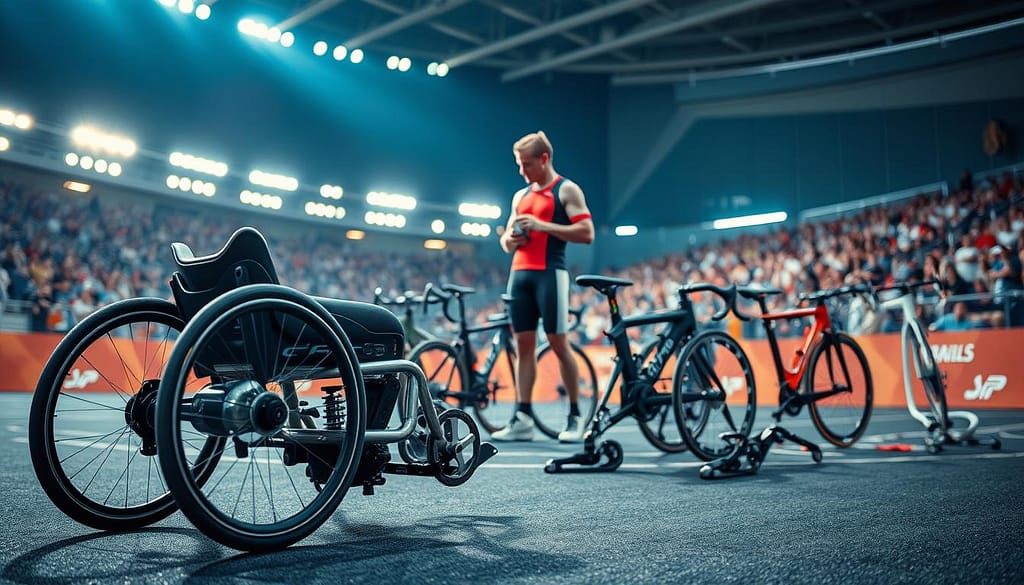
But with great engineering comes great responsibility. Safety isn’t just a waiver; it’s a complex calculus of biomechanics and risk. The very equipment that enables peak performance also introduces new vectors for injury. This is where the concept of ‘safety’ expands beyond helmets and pads. For many Paralympic athletes, the bigger, chronic battle is with pain. Studies, including one in the BMC Journal, show a staggering majority of adaptive athletes manage significant neuropathic or musculoskeletal pain.
So, what’s the modern, if controversial, tool in the recovery kit? For a growing number, it’s cannabinoids like CBD. A striking 93% of participants in one study reported CBD was effective for post-exercise recovery. This isn’t about a counterculture choice; it’s a pragmatic, if politically charged, approach to pain management and sleep—critical factors for an athlete’s “insurance policy” against burnout and injury. It’s the body’s own risk management.
This brings us to the final, critical layer: insurance. Not just the liability waiver, but the holistic coverage of an athlete’s well-being. True safety is a system: the carbon-fiber leg, the anti-inflammatory protocol, and the supportive community that provides a foundation. It’s a holistic view of adaptive equipment that sees the person, not just the hardware. This ecosystem of support is what allows athletes to push boundaries, whether they’re on the slopes or, as seen in the growth of Tennis Canada’s Tennis Month, finding new ways to get in the game.
Athlete Ambassadors and Media
In the digital world, an athlete’s story can be a big deal. But only if the media shares it. For para sport, it’s not just about getting coverage. It’s about being seen as equals.
When a para athlete breaks a record, does it change how we see them? The answer is no, without media attention. Media plays a key role in showing the world what para athletes can do.
Take George Murray, who was on a Wheaties box in 1984. It was a big moment for para sport. It showed that athletes with disabilities are part of the mainstream. Today, the Invictus Games and social media make athletes icons.
The bond between para sport and media is complex. Athletes want to be seen beyond “inspiration porn.” They aim to change how we view human ability.
When athletes like Tatyana McFadden are in ads, they’re not just promoting sport. They’re showing a new way of life. Media can change how we think, moving us from “inspiration” to “records” and “stats.”
The athlete ambassador does more than win medals. They change the way we see human ability. They use media to show the world what’s possible.
Sponsor Deck and Community Partnerships
Remember when corporate sponsorship was just about putting a logo on a banner? Those days are over. Today, a successful inclusion day or adaptive sports event is a team effort. The modern sponsor deck is more than asking for money; it’s about creating value together.
In 1957, the first National Wheelchair Games were a partnership of necessity and vision. Bulova, the watchmaker, didn’t just give money. They provided a venue and gave the event mainstream legitimacy. Today, partnerships like Move United’s PGA partnership for the Military Golf Program are about embedding a brand in a powerful story of resilience and recovery.
The Evolution of the “Ask”: From Logo Placement to Legacy Building
The old model was all about transactions: “Give us money, get your logo here.” Now, it’s about transformation: “Invest in a more vibrant, inclusive community, and your brand becomes part of its story.” A modern sponsor deck for an inclusion day focuses on impact, not just logo placement. It asks about solving problems together, not just how much to give.
Today’s partnerships are more than just money. A local restaurant providing lunch for volunteers is a community pillar. A tech company providing live-streaming equipment is more than a donor; they’re the reason families can watch from afar. This is building infrastructure through partnership.
The Anatomy of a Modern Partnership
What does a value-driven partnership look like? It’s more than just sponsorship tiers. It’s about creating an experience, not just funding an event.
Consider the evolution in partnership models:
| Aspect | Traditional Sponsorship (Then) | Modern Community Partnership (Now) |
|---|---|---|
| Primary Ask | Funding for event logistics | Investment in a shared community outcome |
| ROI for Sponsor | Logo visibility, tax write-off | Authentic brand affinity, employee engagement, social impact story |
| Community Role | Passive beneficiary | Co-creator and primary beneficiary |
| Success Metric | Impressions, clicks | Lives impacted, perceptions changed, community health |
| Partnership Duration | Transactional (event-based) | Relational (sustained programming) |
This table is more than a comparison; it’s a roadmap. The shift from the left column to the right shows the move from charity to partnership. The most successful inclusion day events blur the line between event and community happening. The local bank isn’t just a name on a T-shirt; its employees volunteer as “buddy athletes.” The media sponsor isn’t just buying airtime; they’re telling stories for weeks.
Crafting the “Why”: The Narrative Pitch
The first slide in the deck isn’t a budget breakdown. It’s a story. It starts with a question: “What does a more inclusive community look like, and what role could your brand play in building it?” The deck must answer the “why” before the “what.” It uses data and stories of transformation, not just participant numbers.
The ask is specific. Instead of “We need $10,000,” it’s “Your $10,000 funds an entire adaptive sports clinic for 50 participants, with your team of employee volunteers as activity leaders.” It’s not a cost; it’s an investment with a measurable social return. The smart sponsor today wants to be heroes in a story of progress.
The most powerful inclusion day partnerships are civic marriages. They are long-term, committed, and built on shared values. The local gym that offers its space, the restaurant that feeds volunteers, and the corporation that sends a team to build a wheelchair ramp—they’re not sponsors. They are co-authors of the community’s story. The modern sponsor deck is the invitation to write that story together.
Impact Reporting
The tents are packed, the chalk has settled, and the accountants are asking for the report. What do you tell them? If your impact report only shows attendance and expenses, you’ve missed the point. True impact is about big changes, not just numbers.
Did the volunteers leave wanting to come back next year? That shows a healthy culture. It’s a sign of success.
Look at the numbers from the 2024 Impact Report: 150 climbers from 27 states and 8 countries, 67 volunteers, 34 clinics led by disabled instructors. This data shows more than just numbers. It shows a culture in action.
It’s about the engineer who sees a new use for a harness, or the sponsor who becomes a true partner. This is where simple gear becomes a tool for freedom.
The real value isn’t in a ledger. It’s in the parent who sees their child as an athlete, not just a patient. It’s in the volunteer who keeps coming back, not for a t-shirt, but for the chance to be part of something special.
The legacy isn’t in banners. It’s in changing the way we see skill, grit, and high-performance sport. That’s the return on investment that truly matters.