Patriots Training Camp has given Mike Vrabel a clear coaching platform as of August 20, 2026: rebuild the basics, keep competition honest, and test the roster under controlled pressure. On July 24, 2026, the full squad reported, and Vrabel framed camp around core concepts, earning roles, camaraderie, and preparation to win, according to the team’s official camp update.
That framing matters because New England is not treating camp as a victory lap after the 2025 season. The Patriots went 14-3 and reached the Super Bowl, a rise examined by The Washington Post. The coaching challenge in 2026 is different: keep the foundation intact while giving opponents fewer repeatable answers on tape.
Vrabel’s camp approach has been less about public drama and more about repeatable stress. That does not mean passive work. Pads, competitive matchups, internal scrimmage periods, and joint-practice preparation have all been used to test whether players can carry technique into contact and decision-making into game-like situations.
Patriots Training Camp Priorities Under Vrabel
Why Patriots Training Camp Starts With Roles
Vrabel’s first message was that players have to earn roles. That is a familiar NFL phrase, but the way it is used in camp can shape roster health. A role-based camp gives veterans and younger players a defined standard: assignment knowledge, effort, communication, technique, and response to competition. It also reduces the risk of reading too much into one strong practice or one poor rep.
Christian Gonzalez entered camp in his fourth NFL season with his fifth-year option picked up, while second-round rookie Gabe Jacas had not reported on July 24 because of contract negotiations. Those details are roster facts, not invitations to guess at contract outcomes. From a coaching standpoint, they show why Vrabel’s “earn roles” approach has to work across different player groups: established starters, developing contributors, rookies, and players absent for business reasons.
Stability Without Standing Still
Through the first four practices, the tone of camp was described as steady and even “boring” in a positive sense. In football terms, that can be useful. A quiet camp can signal that meeting routines, teaching language, and practice tempo are being repeated without constant correction. It can also let coaches identify smaller issues before they become habits.
Vrabel returned the full coaching staff, which supports continuity from 2025. Yet the staff has also been asked to bring fresh ideas in offense, defense, and special teams, with attention on third down and the red zone. That balance is central to this camp: New England is not starting over, but it also cannot assume that last year’s answers will hold when opponents have more film.
Physical Teaching And Competitive Boundaries
Hands-On Coaching Without Losing Control
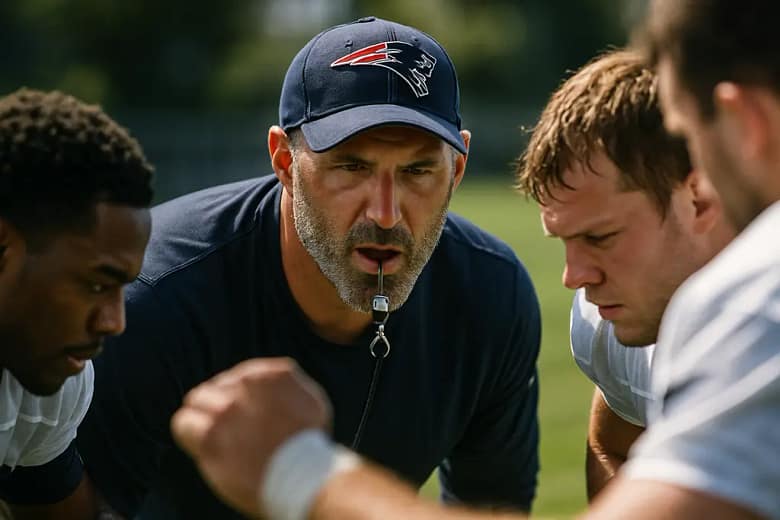
One of the clearest coaching signals came on July 28, 2026, when Vrabel put on pads and lined up during a run-blocking drill. The value of that moment is not that a head coach can still absorb contact. The value is instructional. By entering the drill, Vrabel made the standard visible: pad level, force, leverage at contact, and finish through the rep.
That style fits the identity he has stressed throughout camp. Running backs are expected to run through contact. Pass rushers are expected to finish. Offensive and defensive line work has been framed around force and technique. Physicality alone is not a strategy, but physicality attached to coaching points can become one. The distinction matters for athlete welfare: contact must teach something, not just prove toughness.
Competition With Respect And Situational Discipline
The Gonzalez matchups with A.J. Brown became one of the camp’s sharper competitive reference points, with one-on-one work, team periods, and verbal energy. Vrabel has allowed that type of edge while stressing respect and “taking care of each other.” That is a practical boundary. Coaches want receivers and corners to challenge each other, but they also need players available for the next period, the next practice, and the season.
For athletes, this is where advocacy and performance meet. A camp that rewards competition but ignores control can create unnecessary risk. A camp that limits all friction can leave players underprepared for Sundays. Vrabel’s stated line is situational discipline: compete hard, understand the context, and protect the team’s work.
Situational Football As A Coaching Test
Third Down, Red Zone, And All Three Phases
Patriots Training Camp has placed clear emphasis on situational football. Third down and red-zone periods are not just specialty blocks on the practice script. They are where coaching adjustments become visible. Protection rules, route spacing, quarterback timing, pass-rush lanes, coverage communication, and special teams operation all show up when the field or down-and-distance changes.
The staff’s push for fresh ideas in all three phases reflects a practical concern. After a 14-3 season and a Super Bowl appearance, New England should expect opponents to study tendencies. The answer is not to discard what worked. It is to adjust presentation, timing, personnel usage, and sequencing without losing the core language that players trust.
Blue-White Work And Joint Practice Stress
On August 7, 2026, Vrabel described internal scrimmage work, including a Blue-White game with coaches split up. That format can reveal how players respond when the structure feels less like a normal practice period and more like a game. Coaches can assess substitution awareness, communication, emotional control, and response after mistakes.
On August 11, 2026, Vrabel discussed the move into a joint-practice phase against unfamiliar opponents. The stated areas included fundamentals, special teams, red-zone execution, and pass-rush finishing. Joint practices can be valuable because they remove some of the comfort that comes from facing teammates every day. They also test whether technique holds up when the opponent’s cadence, release plan, pass set, or rush style is less familiar.
Athlete Welfare And Roster Clarity
Recovery Is Part Of The Work
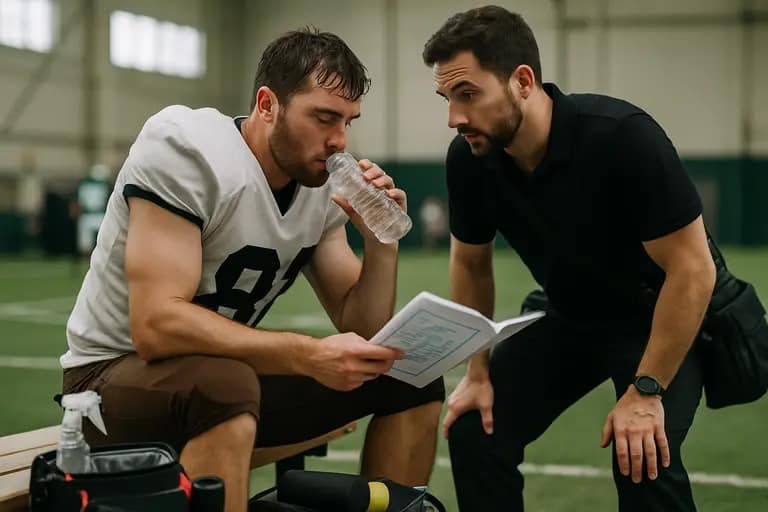
Vrabel has acknowledged that the camp grind is real while aligning the schedule to allow needed work and recovery where possible. That should not be treated as a soft detail. In the NFL, recovery is part of roster building. Players cannot refine technique, compete for roles, or absorb situational teaching if fatigue turns every rep into survival.
This is especially relevant in padded periods and joint-practice work. The coaching staff has to decide where contact is necessary, where a teaching tempo is enough, and where rest protects future performance. Responsible camp analysis should avoid guessing about injuries or private medical timelines. The supported point is narrower: Vrabel’s stated schedule approach recognizes that intensity and recovery must be managed together.
Communication For Young And Established Players
Camp roles affect players differently. A veteran such as Gonzalez may be judged by consistency, leadership in communication, and elite competitive reps. A rookie such as Jacas, once available, would face a different process: installation, technique translation, and proof that college habits fit the pro game. Depth players need clarity on special teams, position flexibility, and practice dependability.
That is why Vrabel’s emphasis on core concepts has value beyond slogans. A clear standard can protect players from mixed messages. It tells them what the staff values and gives them a fairer path to respond. For readers who track how repeatable systems shape performance in other technical fields, CAD/CAM Net offers a useful parallel in how process-focused analysis applies.
What Patriots Training Camp Says About Vrabel
Measured Takeaways For Patriots Training Camp
Patriots Training Camp under Vrabel is best read as a controlled test of identity. The Patriots are not presenting a camp built on novelty for its own sake. The pattern is more specific: retain staff continuity, re-teach core concepts, demand contact-based technique, create competitive matchups, and stress situational football before the regular season.
The caution is that camp performance is not the same as regular-season proof. A strong red-zone period in August does not guarantee red-zone efficiency in October. A physical run-blocking drill does not settle a depth chart. A spirited one-on-one matchup does not define a player’s season. What camp can show is whether the coaching process is coherent.
On that measure, Vrabel’s approach has a clear through line. He is asking the roster to compete for roles while the staff searches for adjustments in all three phases. He is encouraging physical football while setting boundaries around respect and availability. He is using scrimmage and joint-practice settings to test execution against pressure. As of August 20, 2026, that makes New England’s camp less about noise and more about whether last year’s foundation can be sharpened without losing the habits that made it work.