
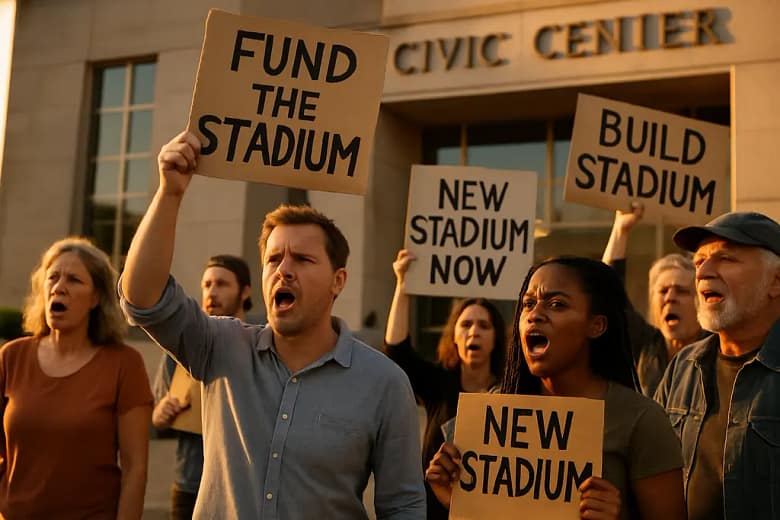
Royals Stadium Funding became a defining Kansas City sports-business issue on August 20, 2026, when the City Council approved two ordinances committing $600 million in city funds toward a proposed downtown ballpark core near Crown Center and Union Station. The vote was not just a stadium vote. It was a public finance decision tied to baseball access, long-term municipal risk, fan trust, and the responsibilities a Major League Baseball club accepts when it asks a city to share the cost of its next home.
The council approved the package 11–2, with council members Johnathan Duncan and Nathan Willett voting no, according to KCUR reported. The ballpark core was described as a $1.9 billion project, while the broader stadium and entertainment district was estimated at about $3 billion. Public partners were expected to cover about $1.14 billion of that wider cost, with the Royals’ private contribution estimated at roughly $760 million.
Royals Stadium Funding And The $600M Vote
The city’s $600 million share sat at the center of the deal. The research record describes the commitment as about $510 million in city-backed bonds for the stadium and about $90 million for infrastructure and site work. That split matters because the fan experience is not limited to seats, scoreboards, and concessions. Streets, transit access, parking movement, pedestrian safety, utilities, and site preparation shape whether a downtown venue works on game days without pushing costs onto residents who may never enter the ballpark.
What Royals Stadium Funding Approved
The August 20 vote did not make every question disappear. As of September 18, 2026, further formal approvals were still needed around council ordinances, state involvement, bond authorizations, and impact area boundaries. That timing should keep the public discussion grounded. A funding package can clear a major political step and still require hard review before money moves at full scale.
The Royals’ proposed location near Crown Center and Union Station made the deal more than a stadium replacement plan. It positioned baseball as an anchor for a larger district. That is where supporters and skeptics often talk past each other. A ballpark can concentrate event traffic and offer a civic gathering place, but those outcomes depend on the quality of the finance plan, the management of public obligations, and the willingness to measure results after approval rather than celebrate projections before delivery.
How The Repayment Structure Shifts Risk
The repayment plan relied heavily on tax increment financing, or TIF. In practical terms, that means new tax revenue growth from the stadium and entertainment district would be redirected over time to repay debt. The research record identifies sales taxes, earnings taxes, local tax growth, parking revenue, gaming-related revenue from the development zone, and a new additional sales tax of up to 1% for 30 years as parts of the structure.
The General Fund Exposure
The key risk is not that TIF exists. Cities use TIF to finance development in many settings. The key issue is what happens if projected district revenues fall short. In this deal, the research record states that Kansas City’s general fund would be legally bound to cover deficits if the dedicated revenues did not meet debt service needs. That is the clause fans, taxpayers, and athlete-rights advocates should keep in view.
A city general fund pays for public services that affect the same communities teams claim to represent. If repayment performs well, the stadium district may carry more of its own weight. If it underperforms, the cost can move closer to ordinary city finances. That does not prove the deal will fail. It does mean the public deserves plain reporting on assumptions, stress tests, and annual performance after bonds are issued.
Public Benefits, Lease Length, And Team Duties
The Royals’ obligations were a core part of the public case for the deal. The research record states that the club committed to a 30-year lease, with up to five possible two-year extensions, which could stretch the term to 40 years. A long lease is one way a city tries to avoid paying for a venue and then facing relocation pressure before the debt has matured. For fans, that matters because loyalty is not an abstract asset; it is built through decades of ticket buying, local media attention, youth participation, and community identity.
Community Benefit Commitments
The Royals also committed at least $55 million in community benefits over the lease term. Axios reported that the package included $14 million for arts; $5 million each for youth sports, the Negro Leagues Baseball Museum, and homelessness services; and $31 million spread across youth, education, safety, and other civic programs, according to Axios Kansas City.
Those categories are meaningful, especially youth sports and the Negro Leagues Baseball Museum. Baseball’s public value is strongest when a stadium deal reaches beyond premium seating and into participation, history, and access. Still, the number should be read against the size of the public commitment. A $55 million community benefit package over a lease term is significant, but it is not the same as a $600 million city finance obligation. The test is whether benefits are enforceable, timed clearly, and reported in a way residents can understand.
Readers tracking the separate lease issues can compare the public finance terms with this Royals lease analysis, especially where revenue sharing, operating duties, and community finance intersect.
Fan Accountability Beyond The Ordinances
Sports-first analysis should start with the people who make the club valuable: fans, workers, youth players, nearby residents, and athletes whose careers depend on the sport’s local pipeline. Public money should buy more than a ceremonial groundbreaking. It should buy clarity, access, and durable civic value. That standard applies whether the venue is a baseball park, an arena, a training site, or a motor sports facility; related sports infrastructure coverage across the same network can be found at Triple T Power Sports.
What Fans Can Track
Fans do not need to become municipal bond lawyers to ask useful questions. They can focus on measurable items that connect public finance to baseball life in Kansas City.
- Whether final bond documents preserve the city’s stated $600 million commitment or alter the public exposure.
- How much repayment depends on new district tax growth rather than existing city revenue.
- Whether the additional sales tax of up to 1% is adopted, how long it runs, and what purchases it affects.
- How the $55 million community benefit commitment is scheduled, audited, and reported.
- Whether youth sports investments reach neighborhoods with the greatest access barriers.
That last point matters to me as an advocate for athlete rights. Stadium debates often focus on owners, elected officials, and real estate. The athletes are not only big leaguers. They are young players trying to find fields, coaches, transportation, and safe places to play. If public dollars help build a professional venue, the development case is stronger when the same deal helps protect the next generation’s access to sport.
Kansas City’s Royals Stadium Funding Test
The most fair reading of the Kansas City deal is cautious, not dismissive. The council vote on August 20, 2026 gave the downtown stadium plan major momentum. The public contribution was large, the private contribution was substantial, and the state’s Show-Me Sports Investment Act was expected to support part of the debt service over 30 years. The project also carried clear uncertainty because several approvals were still pending as of September 18, 2026.
A Sports-First Standard
Royals Stadium Funding should be judged by delivery, not promise. If the district revenues perform, if the lease keeps the club in Kansas City for the long term, if community benefits are paid on schedule, and if the public can see annual reporting, the deal will have a stronger civic case. If revenue misses push costs into the general fund, or if benefits are hard to verify, criticism will be warranted.
Kansas City’s baseball story deserves ambition, but ambition is not a substitute for accountability. A downtown ballpark can serve fans well only if the financing protects public services, the community commitments are real, and the club treats public partnership as an obligation rather than a talking point.