
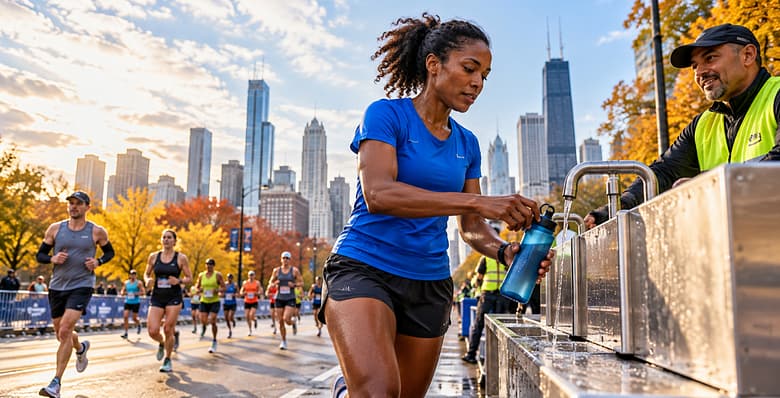
The 2026 Bank of America Chicago Marathon, held on October 11, introduced four dedicated on-course water refill stations, giving runners an additional way to stay hydrated while reducing reliance on disposable containers. Developed in partnership with Culligan International, the initiative represents an important development in how major road races approach environmental sustainability without compromising athlete hydration.
The 2026 Chicago Marathon demonstrates how major sporting events are evolving beyond athletic competition to address environmental responsibility, spectator engagement, and digital accessibility. As fans increasingly follow major races alongside football, basketball, and other professional sports, digital platforms have become important sources of sports information. Resources such as BookmakersReview betting app ratings provide a different perspective on the sports entertainment landscape by helping interested adults evaluate mobile betting platforms, while initiatives like Chicago’s reusable water refill stations highlight how sporting organizations can improve the environmental impact of the live event experience.
The 48th edition of the Chicago Marathon followed a 26.2-mile route through 29 Chicago neighborhoods, beginning and ending in Grant Park. Organizers positioned the new refill stations at miles 5.7, 10.1, 15.7, and 20.3, allowing participants carrying approved hydration equipment to replenish their water supplies during the race.
Chicago became the first Abbott World Marathon Major to formally introduce this type of dedicated personal hydration refill program across its marathon course, according to organizers. The initiative was announced on September 1 and remained a prominent feature of race preparations during October.
The significance extends beyond four additional hydration points. Major marathons face a difficult operational challenge: providing reliable water access to tens of thousands of athletes while managing the packaging, cups, transportation, and waste associated with race-day consumption.
Chicago’s approach suggests that reusable hydration equipment and conventional aid stations can operate together, creating more options for runners while giving organizers an opportunity to reduce disposable waste.
Chicago Marathon 2026 Makes Refillable Hydration Part Of Race Day
The Bank of America Chicago Marathon is among the world’s most recognizable distance-running events. Its flat, fast course attracts elite athletes, recreational runners, charity participants, and international visitors.
For 2026, demand reached another milestone. More than 200,000 people applied to participate, with approximately 55,000 selected for the race, according to NBC Chicago’s September 22 reporting.
That scale makes even relatively modest changes to race operations significant.
A large marathon must provide water at predictable intervals while accommodating runners moving at dramatically different speeds. Aid stations need to operate efficiently, and participants must be able to hydrate without unnecessary congestion.
The new Culligan refill stations were installed immediately before four existing aid stations.
| Refill Station | Course Location | Existing Aid Station |
|---|---|---|
| Station 1 | Mile 5.7 | Aid Station 4 |
| Station 2 | Mile 10.1 | Aid Station 7 |
| Station 3 | Mile 15.7 | Aid Station 12 |
| Station 4 | Mile 20.3 | Aid Station 16 |
These locations provided refill opportunities across different stages of the marathon, rather than concentrating the program near the start or finish.
The stations were intended for runners using approved self-carried hydration equipment, including handheld bottles, soft flasks, fuel belts, and certain running vests.
Importantly, the new infrastructure did not replace conventional water distribution.
Chicago retained its existing aid stations, allowing runners who preferred standard cups to continue using them.
That decision made the program an additional hydration option rather than a mandatory change in how participants carried water.
As explained in the official Chicago Marathon course information, runners could refill approved personal hydration gear with filtered water while continuing to access regular course support.
Why Water Refill Stations Matter For Sustainable Sporting Events
Water is essential to endurance sports, but providing it to large numbers of participants creates environmental challenges.
Traditional marathon hydration systems depend heavily on disposable cups, packaging, and the logistical infrastructure required to distribute drinks across an extended route.
Even when paper cups replace plastic cups, the environmental challenge does not disappear.
Paper products require raw materials, manufacturing, transportation, and waste collection. Contaminated or heavily soiled cups may also be difficult to recycle, depending on local processing systems.
Plastic bottles introduce additional concerns related to fossil-based materials, collection, recycling capacity, and the possibility of discarded packaging entering the environment.
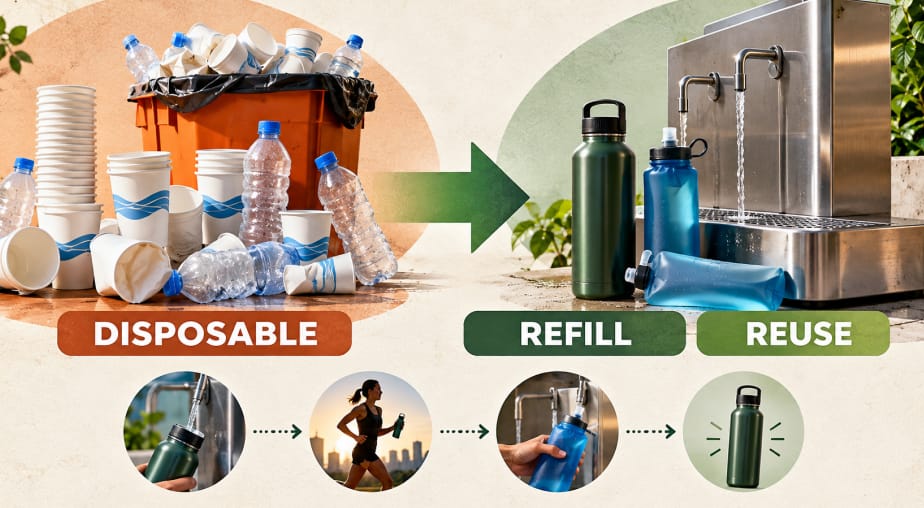
Reusable hydration systems offer another approach.
Rather than receiving a new container at each drinking opportunity, runners carry a bottle or flask that can be refilled repeatedly.
The environmental benefit depends on several factors, including how often the container is reused, how much disposable packaging it replaces, and the resources required to manufacture and maintain the refill infrastructure.
A refill station alone does not guarantee a measurable reduction in plastic pollution.
However, providing accessible refill infrastructure removes one practical obstacle to using reusable containers during large sporting events.
For runners already accustomed to carrying hydration equipment during training, the option can make race-day habits more consistent with their everyday routines.
Chicago’s initiative is particularly relevant because it introduces that choice at an event operating on an international scale.
If refill systems prove practical at a major marathon, smaller races may find opportunities to adopt similar infrastructure suited to their own budgets and participation levels.
How Culligan And HydraPak Supported The New Hydration System
The 2026 refill program brought together two companies with different roles in sports hydration.
Culligan International supplied the water-treatment and refill infrastructure. HydraPak, a manufacturer of hydration equipment, supported the use of personal containers such as soft flasks and reusable race cups.
Culligan’s systems use high-capacity activated carbon filtration, which the company says helps reduce certain contaminants, unpleasant tastes, and odors.
For a large sporting event, filtration is only one component of the operation.
Water must also be dispensed quickly enough to accommodate athletes moving through a narrow section of the course.
Unlike a refill station at a school or public park, a marathon refill point may experience concentrated demand as groups of runners arrive within a short period.
The system must therefore balance water quality, dispensing speed, accessibility, and crowd movement.
HydraPak’s involvement reflects another important aspect of sustainable sports hydration: equipment design.
Soft flasks and collapsible containers can be easier to carry than rigid bottles during endurance events. However, runners must be comfortable using them while moving and understand how to refill them efficiently.
An October report from Running Insight on the Culligan partnership highlighted the new infrastructure and its role in the marathon’s broader environmental strategy.
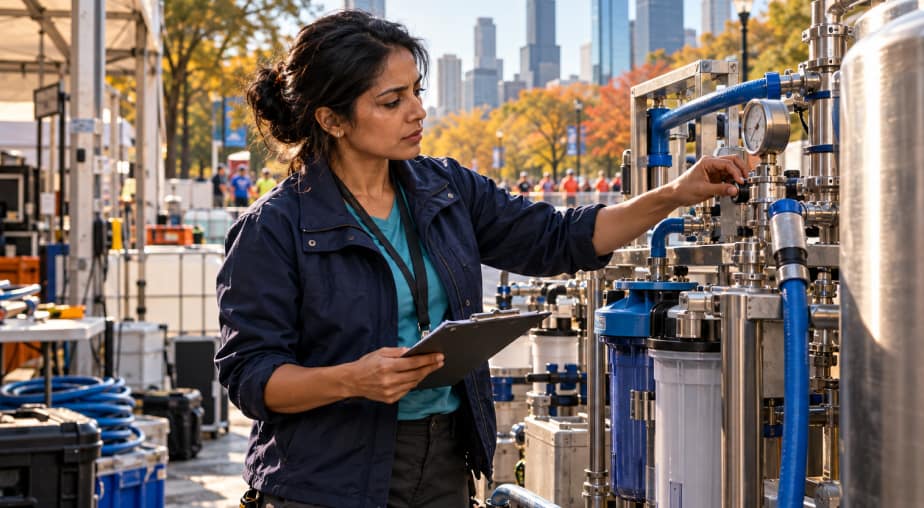
The partnership illustrates why reducing disposable containers requires more than encouraging athletes to bring reusable bottles.
Organizers must also provide compatible equipment guidance, convenient refill locations, and dependable water distribution.
What The 2026 Race Revealed About Refill Station Performance
The October 11 race attracted more than 54,000 participants, according to the marathon’s post-race announcement.
Kenya’s Amos Kipruto won the men’s race in 2:01:09, while Ethiopia’s Hawi Feysa defended her women’s title in 2:13:33.
American runners also delivered notable performances. Clayton Young finished in 2:05:23, and Emma Grace Hurley ran 2:20:47 in her marathon debut.
Those results reinforced Chicago’s reputation as a major international running event. They also demonstrated the scale of the environment in which the new hydration infrastructure operated.
Early participant reactions to the refill stations were encouraging.
In a discussion published on October 13 in the Chicago Marathon Reddit community, several runners described the refill process as quick and convenient. One participant reported using the stations to refill a handheld flask without encountering lines.
These accounts provide useful qualitative feedback, but they are not a representative evaluation of the entire field.
A small number of positive experiences cannot establish average refill times, overall participation rates, or total waste reductions.
As of October 20, publicly available information reviewed for this article did not establish how many runners used the four stations or how many disposable containers were avoided specifically because of the 2026 on-course program.
That distinction matters.
A successful environmental initiative should ultimately be evaluated through measured results, not simply the installation of new equipment.
Chicago has already demonstrated that refill infrastructure can be incorporated into a major marathon. The next question is how much waste the system actually prevents.
Chicago’s Environmental Strategy Extends Beyond Water Stations
The refill initiative builds on several years of sustainability work by the Bank of America Chicago Marathon.
The event’s official sustainability information identifies initiatives involving transportation, waste management, water distribution, community engagement, and environmental certification.
One particularly relevant figure comes from 2024.
According to organizers, Culligan refill stations in Grant Park helped avoid the use of approximately 14,680 plastic bottles that year.
That figure demonstrates the potential of refill infrastructure at the marathon’s start, finish, and associated event areas. It should not, however, be presented as the measured impact of the four new on-course stations in 2026.
The event has also promoted alternatives to disposable water bottles, public transportation for spectators, and bicycle valet services.
Its sustainability program includes work with the Council for Responsible Sport and participation in the United Nations Sports for Climate Action initiative.
These measures address different parts of the event’s environmental footprint.
Hydration infrastructure targets disposable packaging and drinking-water access.
Public transportation and cycling facilities address some transportation-related impacts.
Waste-management programs focus on collecting, separating, and processing materials generated during the event.
The Chicago Marathon’s sustainability and social impact program provides additional information about these efforts and their development over time.
The broader lesson is that no single initiative can make a major sporting event environmentally sustainable.
A refill station can reduce the need for certain disposable containers, but it does not eliminate transportation emissions, discarded clothing, food packaging, or other event-related impacts.
Meaningful progress requires coordinated improvements across several operational areas.
Can Reusable Bottles Replace Disposable Cups At Major Marathons?
The introduction of refill stations raises an important question about the future of marathon hydration.
Could major races eventually operate without disposable cups?
The answer depends on athlete safety, event logistics, equipment availability, and the environmental performance of different hydration systems.
At Chicago, the 2026 program preserved traditional aid stations while adding a refill option.
This approach allowed runners to choose the hydration method that suited their needs.
Elite competitors often prioritize rapid fluid access without carrying additional equipment. Recreational runners may have different preferences, particularly if they already train with handheld bottles or hydration vests.
Weather conditions can also influence hydration needs.
An event held in warm or humid conditions must provide sufficient fluid access without creating unnecessary delays.
Removing conventional aid stations before establishing a reliable alternative could create avoidable problems for participants.
For that reason, a gradual transition may be more practical than immediately requiring every runner to carry a reusable container.
Chicago’s model offers a way to evaluate runner behavior before making more extensive changes.
Organizers can observe whether refill stations attract sustained use, whether congestion develops, and whether participants report difficulties with the equipment.
The environmental case also needs careful assessment.
Reusable bottles have manufacturing impacts of their own. Their benefits generally depend on repeated use over time rather than a single appearance at one event.
A runner who uses the same bottle throughout training, racing, and everyday activities is likely to make better use of the product than someone who purchases a new reusable bottle for every race.
The goal should therefore be to encourage durable hydration habits rather than simply replace disposable merchandise with reusable products that are rarely used.
What Smaller Running Events Can Learn From Chicago
The Chicago Marathon’s program offers lessons for community races, school athletic programs, charity runs, and regional sporting events.
Smaller organizations may not have the resources to install high-capacity filtration systems at several points along a course.
However, the underlying principles can be adapted to different event sizes.
Organizers can begin by identifying where participants need water most, assessing existing drinking-water infrastructure, and determining whether refill stations would complement conventional hydration services.
They can also encourage athletes to use reusable equipment during training so that refilling becomes familiar before race day.
Clear communication is essential.
Participants should know where refill stations are located, which containers are compatible, and whether conventional drinking-water services remain available.
Volunteer training is equally important because refill stations must operate efficiently when runners arrive.
For school races and youth athletic events, the educational opportunity may be especially valuable.
A reusable-bottle program can connect environmental awareness with everyday sports participation, helping young athletes understand how personal habits and event infrastructure influence waste generation.
The same principles apply to soccer tournaments, basketball competitions, cycling events, and outdoor recreation programs.
Unlike a marathon, many of these events take place at fixed venues where permanent refill infrastructure may be easier to install and maintain.
A school athletic complex, for example, could provide bottle-filling stations that serve students during physical education, practices, competitions, and ordinary school days.
That creates opportunities for repeated use throughout the year rather than during one annual event.
How Major Races Should Measure Plastic Waste Reduction
Installing refill stations is a visible improvement, but measuring their environmental impact requires more detailed information.
Organizers should track both how the equipment performs and whether it changes participant behavior.
Several indicators would be especially useful:
- Refill activity: Total water dispensed, number of refills, and usage patterns at different course locations.
- Disposable material consumption: Changes in the number and weight of cups, bottles, and other hydration-related materials distributed.
- Operational performance: Refill speed, equipment reliability, water availability, and participant feedback.
- Environmental outcomes: Waste collected, materials recovered, and estimated packaging avoided using transparent calculation methods.
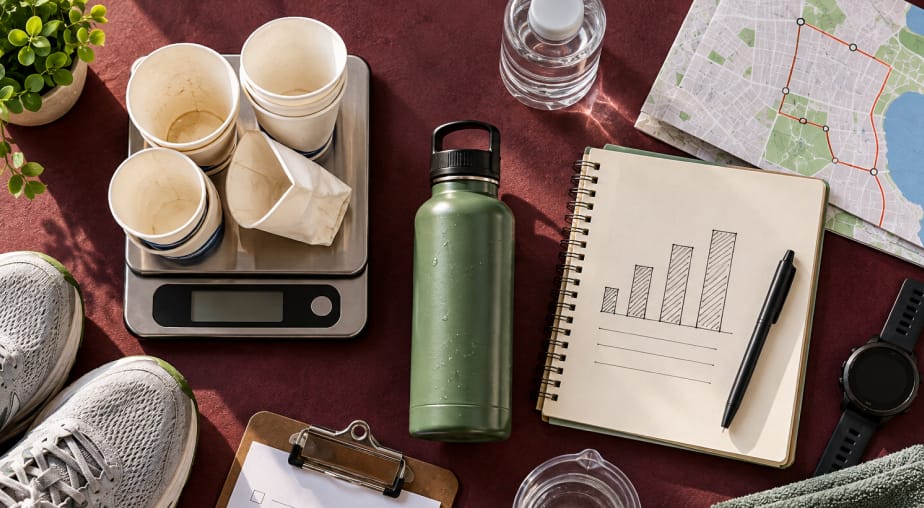
These measurements should be compared with previous events while accounting for changes in participant numbers, weather, and race operations.
For example, an increase in total waste does not necessarily mean a sustainability program failed if the number of participants grew substantially.
Conversely, fewer discarded cups would not automatically prove that the entire event’s environmental footprint declined.
Reliable evaluation requires consistent data and an understanding of what each measurement represents.
Water quality should also remain part of the assessment.
Filtration systems must be maintained appropriately, and organizers should follow applicable drinking-water requirements.
Environmental goals should never come at the expense of safe hydration.
Why Chicago’s Refill Experiment Matters Beyond Running
The 2026 Chicago Marathon provides an example of how environmental improvements can become part of mainstream sports operations.
Its four on-course refill stations did not eliminate disposable cups, and their precise impact on plastic waste has not yet been publicly established through the information reviewed here.
Nevertheless, the program expanded access to reusable hydration during one of the world’s largest road races.
That is an important operational change.
The initiative also challenges the assumption that sustainability measures must make sporting events less convenient.
Early runner feedback suggests that some participants found the refill stations easy to use, although broader performance data is still needed.
For other major marathons, the next step is to evaluate whether similar systems can operate efficiently under different course conditions and participant volumes.
For community organizations, the lesson is more immediate: accessible refill infrastructure can make reusable hydration a practical part of sporting participation.
The most valuable long-term outcome would not simply be more refill stations at major races.
It would be a shift toward sporting environments where athletes, spectators, schools, and organizers routinely have convenient alternatives to disposable water containers.
Chicago’s 2026 initiative offers a useful starting point. Its lasting environmental significance will depend on whether organizers measure the results, refine the system, and make reusable hydration increasingly accessible without compromising athlete needs.