
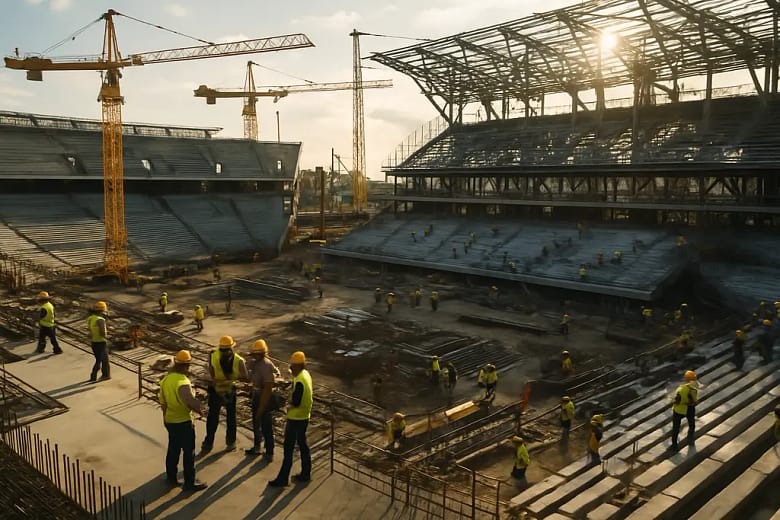
Venue infrastructure is now a competitive issue, not just a construction issue. Stadiums are judged by how they serve athletes, fans, workers, neighborhoods, and the public balance sheet. Allegiant Stadium in Las Vegas and the Kansas City Royals’ planned downtown ballpark show two sides of the same question: what should a major sports venue prove before public trust follows?
For teams, the answer starts with the event itself. A building has to move crowds safely, protect field and playing conditions, control energy and water demand, support event workers, and give fans predictable access. For cities, the standard is wider. If public money or public land is involved, officials should be able to explain the expected return, the environmental gains, and the trade-offs with other civic needs. That test is not anti-stadium. It is pro-accountability.
Why Venue Infrastructure Sets The Stakes
Major venues now operate as year-round civic machines. They host regular-season games, postseason events, concerts, college events, international exhibitions, and private bookings. That schedule creates pressure on power systems, waste systems, transit plans, restrooms, food service, security, communications, and nearby streets. The better question is not whether a stadium looks modern on opening day. The better question is whether the building can perform under heavy use without shifting hidden costs to fans, workers, or taxpayers.
Venue Infrastructure As A Sports Operations Issue
Good venue infrastructure protects the sport product. Reliable energy systems reduce the risk of event disruption. Water-saving fixtures lower strain during packed event calendars. Waste sorting and food recovery programs affect back-of-house operations, not just public image. Transit and parking choices shape whether fans arrive early enough to support concessions and whether staff can get to shifts without unreasonable burdens.
This is where athlete rights and fan rights overlap with sustainability. A stadium that uses less water, manages heat, improves lighting, and moves people more efficiently can support safer, more predictable event conditions. The evidence still has to be verified. Public claims about jobs, savings, energy, or community benefits should be measured after opening, not accepted as permanent proof at the announcement stage.
The Public-Money Test
Sports venues often promise economic activity, civic pride, and district development. Those promises should be tested against hard figures: how much public money is committed, what infrastructure is included, who owns the risk, and whether community benefits are enforceable. Back2Tap has covered that issue in its separate analysis of the Royals stadium deal, where public value depends on more than the headline construction cost.
Local reporting also matters because stadium projects are lived at street level. If you’re looking to see how civic projects compare across communities, remember that Ambikapur City provides a useful perspective on the importance of local context in infrastructure debates.
Allegiant Stadium As A Working Case
Allegiant Stadium gives planners a working example of what sustainability systems can look like after a building is already operating. According to the research provided, the Las Vegas stadium had achieved LEED Gold Certification by 2023, signaling recognized performance in sustainable construction, energy efficiency, water savings, and resource management. The certification does not settle every question about cost or event impact, but it gives the discussion a documented benchmark.
Resource Systems That Can Be Counted
The reported numbers from Allegiant are substantial. In 2024, the stadium diverted more than 3,662,551 pounds of waste from local landfills through composting, recycling, and reuse programs. Water-efficient fixtures were reported to save an estimated average of 535 million gallons of water in a typical event-filled year. The stadium also was reported to operate on 100% renewable energy sourced from Nevada power supplies.
Those figures matter because they describe operational systems, not only design intent. A stadium can be built with sustainability language and still fall short if its daily operations do not sort waste, recover materials, or reduce utility demand. Allegiant’s reported annual recycling of more than 89,380 pounds of rubber turf pellets and composting of 158,680 pounds of grass clippings and landscaping waste in 2024 point to a building that treats materials as an ongoing management task.
Food, Waste, And Event-Day Labor
The food system is another useful lesson. The research notes that large events at Allegiant collect an average of 12,000 pounds of kitchen prep cuttings and food scraps, which are then repurposed for local livestock feed. A separate cigarette waste-to-energy initiative reportedly generated about 74,900 watts of energy, described as enough to charge about 14,993 cell phones for one hour.
These programs may sound small compared with a full stadium’s power demand, but they show how sports venues can break waste into measurable streams. That matters for workers, too. Sustainability is not only a scoreboard graphic. It depends on training, sorting stations, vendor compliance, loading-dock routines, and post-event cleanup. If the labor plan is weak, the environmental plan usually weakens with it.
Royals Deal And Public Value Tests

The Royals case puts venue infrastructure inside a larger civic decision. On April 22, 2026, the Kansas City Royals and Hallmark Cards unveiled plans for a $1.9 billion downtown stadium and a broader $3 billion mixed-use development at Crown Center, with an expected 20,000 construction-phase jobs and an opening targeted for the 2030 season, according to the MLB announcement.
On August 20, 2026, Kansas City Council approved a framework committing $600 million of public funds through city-backed bonds and infrastructure funding toward the $1.9 billion stadium, including $90 million dedicated to city infrastructure improvements tied to the project, according to the Kansas City release. Those dates matter. As of October 3, 2026, the council action had already occurred, so the public debate had moved from concept toward delivery standards and oversight.
Existing Assets Change The Cost Question
The Royals plan also shows why existing assets can be strategically important. The research notes that the proposed ballpark would use 9,000 parking spaces at Crown Center and existing Kansas City streetcar stops along Main Street. If those assets perform as intended, the project could reduce the need for new parking construction and limit some redundant infrastructure. That claim should still be checked against game-day traffic, employee access, disability access, street closures, and crowd movement data once the site plan advances.
Using existing parking and transit is not automatically sustainable. It depends on how many fans can realistically use those options, how late service runs, how safe the walking routes feel, and whether workers have affordable transportation after events. A downtown ballpark can improve access for some fans while creating strain for others if the plan does not account for shift workers, families, older fans, and people with mobility needs.
Community Commitments Need Follow-Through
The research states that the Royals committed $55 million upfront to local initiatives, including $5 million each for homelessness programming and the Negro Leagues Baseball Museum, along with improvements such as lighting and safety at Washington Square Park. Those commitments connect the ballpark plan to civic priorities beyond baseball. The key accountability question is whether the commitments are tracked with dates, budgets, recipients, and public reporting.
That is where sports leadership should be clear. Community benefits should not be treated as public-relations offsets for a large public contribution. They should be written, monitored, and evaluated. If a stadium district benefits from public bonds, public streets, and public services, then the public deserves a clear record of what was promised and what was delivered.
Venue Infrastructure Lessons From Allegiant And Royals
The lesson from both cases is that venue infrastructure should be evaluated in layers. Allegiant shows the value of operational proof: waste diversion, water savings, renewable power sourcing, food-scrap reuse, and material recovery. The Royals deal shows the importance of financial and civic proof: public funding levels, existing parking and streetcar access, city infrastructure spending, and community investments tied to a specific district plan.
For future sports projects, the strongest standard is not the biggest renderings or the loudest promises. It is a public scorecard that follows the venue from approval to opening and then through several years of operations. That scorecard should include resource use, waste diversion, transit performance, public cost, construction jobs, permanent jobs, safety outcomes, and community-benefit spending. Teams should welcome that level of review if the project is as strong as advertised.
Sports can lead on sustainability, but leadership requires proof. Allegiant’s reported systems show how a stadium can manage resources after the ribbon-cutting. Kansas City’s Royals framework shows how public funding raises the need for plain-language accountability before the first pitch in a new park. Both cases point to the same standard: build for the game, measure for the public, and keep the people who make sports possible at the center of the deal.