World Cup infrastructure after the 2026 tournament deserves a sports-first review because the work around security and transport shaped the match-day experience as much as stadium seating, kickoff times, or squad depth. From June 11 to July 19, 2026, the tournament placed unusual pressure on host cities in Canada, the United States, and Mexico, and the public record shows a clear pattern: the best upgrades were those that moved supporters safely, protected teams and workers, and reduced dependence on private cars.
As an advocate for athlete rights and sustainable sports operations, I view these projects through a practical lens. Security was not only about gates and airspace. Transport was not only about moving crowds. Both affected player recovery windows, staff travel, emergency access, accessible routes, and the ability of local residents to keep moving while global soccer took over city streets. The strongest lessons from 2026 came where agencies treated public safety, transit, walking, cycling, and accessibility as connected parts of match operations.
World Cup Infrastructure And Public Safety Spending
Canada co-hosted 13 matches during the 2026 FIFA World Cup, with seven in Vancouver and six in Toronto. Before the tournament, the Government of Canada committed up to CAD 145 million to support public safety and security in those two host cities, according to Canada’s public safety announcement. That funding sat at the center of a wider operational question: could a soccer event at global scale protect visitors and residents without turning host neighborhoods into closed-off zones?
World Cup Infrastructure As Match Operations
World Cup infrastructure worked best in 2026 when it supported the actual rhythm of tournament play. A match day is not a single crowd movement. It includes team arrivals, broadcast crews, accessible entry, volunteer shifts, post-match dispersal, and late-night transit demand. Security and transport spending had to cover that full cycle. For athletes, the standard should be simple: safe arrival routes, stable venue perimeters, and emergency planning that does not add unnecessary stress to preparation or recovery.
The United States used a federal grant program to strengthen security and preparedness across its 11 host cities. The research record identifies USD 625 million in awards announced on March 18, 2026, covering police and emergency response at stadiums, venues, and transportation hubs, as well as cybersecurity, background checks, and operational exercises. Those categories show how modern tournament security extended beyond visible staffing. Digital systems, credentialing, and rehearsed coordination became part of the sports product itself.
Security Funding In Canada And The United States
Airspace security also became a defining feature of the tournament. In the United States, the FAA set up nearly 250 temporary flight restrictions covering match venues, fan festivals, team hotels, and training sites, and federal officials reported that more than 700 unauthorized drones were seized during counter-drone operations, according to the U.S. Department of Transportation’s counter-drone report. Those figures should be read carefully: they point to the scale of risk management around high-profile soccer, not to a single solution for every future event.
The athlete-rights angle matters here. Drone incursions and uncontrolled airspace can affect privacy, tactical preparation, and team security, especially around hotels and training sites. At the same time, security programs must be accountable to host communities. Heavy police presence, surveillance technology, and crowd monitoring can protect people, but they also require clear limits, public reporting, and after-action review. A safer tournament should not mean indefinite emergency measures after the final whistle.
Transit Operations In Vancouver And Toronto
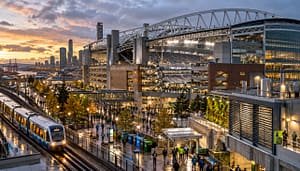
Transit was one of the clearest ways the 2026 tournament connected sports delivery with sustainability. In Metro Vancouver, TransLink scaled service during the tournament with about 600 additional bus trips per day, more frequent SkyTrain service, extended hours, special SeaBus sailings, and West Coast Express match-day service. Those measures gave supporters practical alternatives to car trips into the stadium district and helped spread demand across the region.
Vancouver Used Extra Service To Absorb Demand
Vancouver’s match-day numbers show why transit planning belonged at the center of World Cup infrastructure. SkyTrain stations near BC Place recorded average ridership increases of 54% on match days. Across the region, match days added about 87,000 boardings per day on average, and system-wide ridership reached roughly 1.4 million on June 24, 2026, when Canada played Switzerland. Those figures suggest that public transport did more than support the tournament; it absorbed a large share of event pressure that otherwise could have shifted to roads, curb space, and neighborhood parking.
Metro Vancouver also used a safety and security framework that included visible Transit Police and security officer deployments, an Emergency Coordination Centre active from June 8 to July 22, 2026, designated HandyDART pick-up and drop-off points near BC Place and fan festival sites, and real-time crowd monitoring. The accessibility detail should not be treated as a side item. Para athletes, older fans, disabled supporters, families, and workers all benefit when accessible transport is planned before crowds arrive rather than patched together during disruption.
Toronto Built Match-Day Movement Around Transit
Toronto activated a Mobility Plan for June 11 to July 19, 2026. The plan accounted for more than 45,000 spectators per match at Toronto Stadium and up to 20,000 people at the FIFA Fan Festival at Fort York and The Bentway across 22 operational days. Measures included expanded transit service, transit-only lanes on Dufferin and Bathurst through RapidTO, a dedicated Fleet and Strachan transit hub for pick-ups and drop-offs, enhanced staffing, and added signage.
The TTC also introduced safety initiatives before the tournament, including a bike-based Special Constables Core Response Unit, tethered drone pilots at select subway yards for surveillance and real-time detection of damage or graffiti, and a drone on match days to monitor crowding at the Fleet Street Transit Hub. These measures show a city trying to pair operational speed with situational awareness. They also raise a fair governance question: after a tournament ends, agencies should disclose what worked, what did not, and which tools remained in use.
Eco-Friendly Mobility Measures In Host Cities

The sustainability case for event transport is often strongest where it is least flashy. More buses, trains, walking routes, bike parking, and secure pedestrian corridors can cut car dependence while improving access for local residents. Across 2026 host planning, FIFA’s environmental pillar required host cities to use sustainable building standards for stadiums and temporary infrastructure, promote energy efficiency and renewables, encourage hybrid, electric, and hydrogen vehicles in transport fleets, reuse tournament materials, and improve public transport, walking, and cycling for fan mobility.
Mexico Linked Mobility Work To Stadium Access
Mexico’s federal government announced mobility investment of between 1,500 and 2,000 million pesos, about USD 75 million to USD 100 million, for each of three host states: Ciudad de México, Jalisco, and Nuevo León. The projects identified in the research included Metro line extensions and renovations, new electromobility routes, bike parking, secure access to stadiums, lighting, security cameras, and pedestrian and cyclist corridors. That mix matters because lower-carbon travel requires more than vehicles. It needs safe last-mile access, clear lighting, and routes that supporters trust after night matches.
For readers interested in the civic side of sports across our network, Ambikapur City offers relevant local insights on public planning and community issues. The connection is direct: mega-events can set expectations for safer streets, better transit, and public accountability long after international fans leave.
Venue Changes Had Accessibility Value
Vancouver’s BC Place also received upgrades before the tournament, including accessibility improvements, new hospitality spaces, upgraded technology, and a hybrid natural-grass pitch. The pitch detail belongs in an eco-friendly sports discussion because playing surfaces sit at the intersection of athlete performance, venue operations, and maintenance demands. The available research does not provide a verified emissions comparison for the hybrid pitch, so the responsible reading is narrower: it was part of the stadium upgrade package and had direct relevance to match quality and player welfare.
The same caution applies to broad sustainability claims. The 2026 record supports a clear finding that host cities invested in transit capacity, pedestrian movement, cycling access, security systems, and accessibility. It does not, from the provided research, allow a precise carbon accounting across all host cities. That gap should push future organizers toward public measurement, not marketing language. A related Back2Tap review of World Cup grants raised the same accountability issue around standards, funding, and public value.
Security And Transport Standards From The 2026 World Cup
By October 17, 2026, the strongest evidence from the concluded tournament pointed to a practical standard for future hosts: sports infrastructure should be judged by how safely and efficiently it served the match, not by how large the capital program sounded before kickoff. World Cup infrastructure in 2026 showed that security and transport were not background services. They were part of competitive conditions, fan safety, labor conditions, and environmental performance.
What Future Hosts Can Verify
Future host cities should publish clear post-event data on transit ridership, crowd incidents, accessibility performance, emergency response times, drone interventions, and the continued use of surveillance tools. They should also separate temporary tournament spending from lasting public assets. A bus service plan that disappears without review has a different civic value than station access, cycling corridors, or safer pedestrian routes that remain in daily use.
The fairest reading of World Cup infrastructure after 2026 is neither celebration nor rejection. Canada’s public safety funding, U.S. counter-drone actions, Vancouver’s transit surge, Toronto’s mobility plan, and Mexico’s mobility investments all showed serious preparation for a mega-event. The next test is whether sports leaders, public agencies, and governing bodies treat those lessons as obligations: protect athletes, move fans with lower-carbon options, respect local residents, and make every major event leave behind evidence that can be audited.