
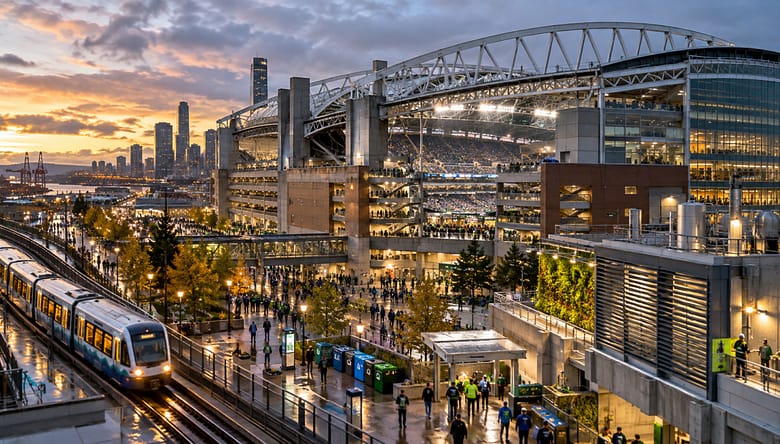
Lumen Field has spent a quarter-century building a reputation around noise, football and the unmistakable Seattle skyline. Now the home of the Seattle Seahawks has another distinction: one of the highest environmental credentials available to a major sports venue.
On October 6, 2026, the Seahawks announced that Lumen Field had earned LEED Platinum certification, the highest level in the Leadership in Energy and Environmental Design rating system administered by the U.S. Green Building Council. According to the official Lumen Field announcement, the Seattle venue is only the fourth NFL stadium to achieve LEED Platinum.
What makes the achievement particularly significant is the age and workload of the building. Lumen Field opened in 2002 rather than emerging as a new stadium designed around the latest environmental standards. It is home to the NFL’s Seahawks, MLS’s Seattle Sounders FC and NWSL’s Seattle Reign FC, while its broader complex accommodates concerts and other major events.
The result provides a useful case study for the sports industry. Building greener stadiums matters, but so does improving the enormous inventory of venues that already exist. The growing emphasis on sustainability is also changing how the wider sports industry is evaluated, with fans increasingly looking beyond what happens on the field to understand how venues, teams, and related sports businesses operate. Just as independent resources such as the BetAnySports review examine services within another part of the sports ecosystem, environmental certifications provide spectators with additional information for assessing the organizations and facilities connected to the games they follow.
LEED Platinum Rewards More Than One Green Upgrade
LEED Platinum should not be understood as an award for installing solar panels, changing light bulbs or launching a recycling campaign. LEED evaluates environmental performance across multiple areas of building design and operation.
Lumen Field said its certification included sustainability features involving energy efficiency, water conservation, waste diversion, green cleaning and local food and beverage sourcing. The certification therefore reflects a collection of operational decisions rather than one showcase project.
That distinction matters for professional sports.
A stadium is essentially a small city that repeatedly fills and empties. Food has to be prepared, bathrooms supplied, lights operated, waste collected and transportation managed for tens of thousands of visitors, often within a matter of hours. Lumen Field’s campus hosts hundreds of event days and attracts more than two million visitors annually, making environmental improvements potentially significant when multiplied across an entire season.
The venue’s approach also illustrates how sustainability can become part of normal stadium management instead of an isolated campaign.
Peter Templeton, president and CEO of the U.S. Green Building Council, described the certification as an example of green-building leadership and emphasized the potential for local operational solutions to contribute to broader environmental progress. The U.S. Green Building Council has increasingly emphasized building performance, energy efficiency and reductions in greenhouse-gas emissions within its LEED framework.
For sports organizations, that performance-based approach is important. A sustainability strategy ultimately becomes more credible when measurable operational changes sit behind the environmental messaging.
The Stadium’s Waste Numbers Show How Much Can Change
Perhaps the clearest evidence of Lumen Field’s long-term transformation comes from its garbage.
When the stadium began tracking waste in 2006, its diversion rate was just 4.66%. Nearly two decades later, the operation looks radically different.
During the one-year tracking period used for its TRUE Gold certification, Lumen Field’s closed-loop recycling program diverted more than six million pounds of material from landfill, producing a 93% diversion rate. In November 2025, the venue became only the second NFL stadium to earn TRUE Gold Certification for Zero Waste.
That improvement did not happen simply because fans were asked to recycle more carefully.
In 2022, Lumen Field introduced an on-site sorting system known as MRFi, allowing materials including compost, cardboard, aluminum and plastic to be separated more efficiently. The system helped reduce the time required to sort waste after events from approximately five days to 36 hours.
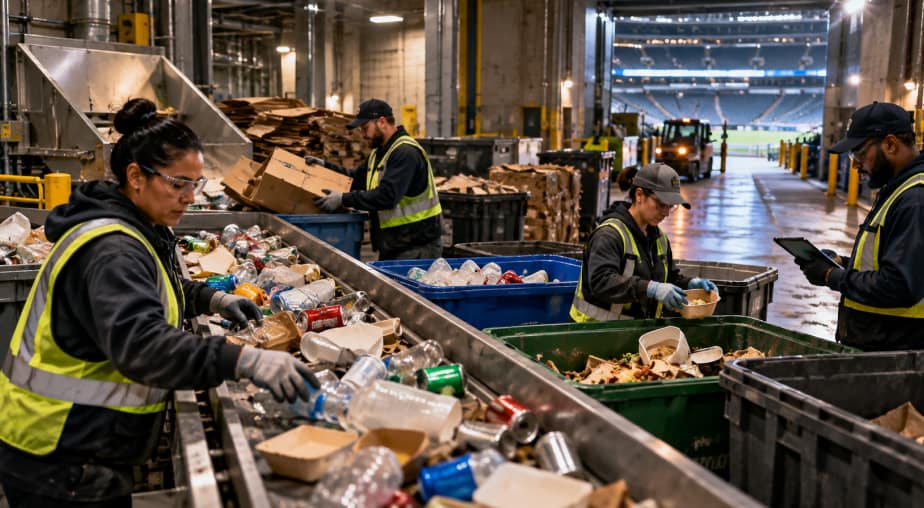
The infrastructure continues to evolve. In August 2026, Lumen Field announced the installation of new three-stream waste and recycling units around the stadium. The receptacles were constructed from recycled high-density polyethylene lumber and designed with interchangeable components so their configurations can be altered as the venue’s diversion program changes.
That detail may sound less exciting than a new scoreboard or premium seating section, but it demonstrates something important about sustainable stadium management: environmental progress often depends on improving ordinary systems that operate during every event.
Water Conservation Adds Up Across A Full Season
Water provides another example of incremental improvements producing meaningful results.
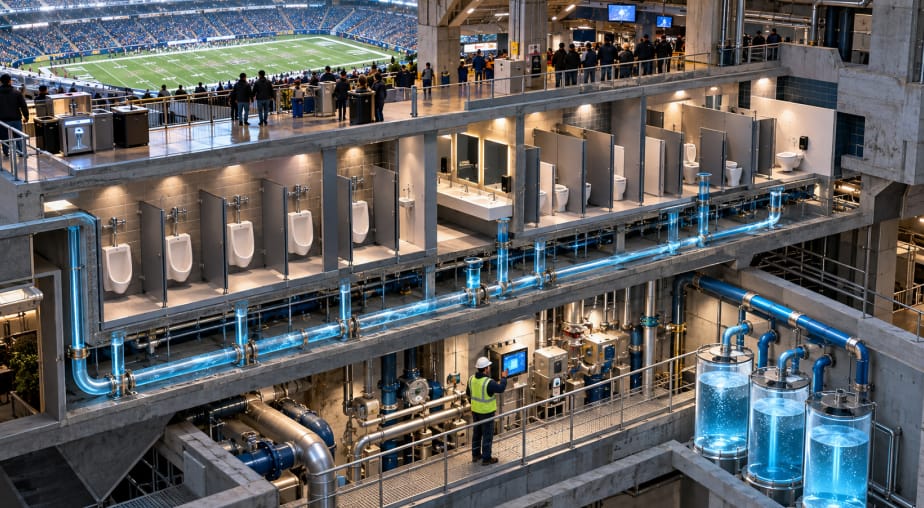
According to Lumen Field’s stadium data, 100% of its urinals have been retrofitted with low-flow fixtures, saving more than 1.3 million gallons of water annually.
A single fixture upgrade is easy to overlook. Multiply the savings across 63 stadium restrooms, however, and then across NFL games, MLS matches, NWSL matches, concerts and other events, and the scale becomes more substantial.
This is where an older venue’s sustainability story differs from that of a newly constructed arena. Lumen Field cannot simply redesign every system from scratch. Operators instead have to identify existing equipment, processes and infrastructure that can be upgraded without interrupting the building’s primary purpose.
That makes the LEED Platinum designation particularly relevant to cities filled with older stadiums and arenas.
The lesson is not necessarily that every venue should copy Seattle component by component. It is that aging sports infrastructure does not automatically have to become environmentally obsolete.
Local Food Turns Concessions Into Part Of The Strategy
Stadium sustainability also extends to what spectators eat.
Lumen Field’s Home Taste Advantage program incorporates food supplied by vendors within a three-mile radius of the stadium, while food service uses compostable containers and utensils as part of the venue’s waste-reduction program.
Local sourcing can shorten portions of the supply chain while connecting stadium spending with nearby businesses. Compostable serviceware, meanwhile, works alongside the venue’s sorting and diversion infrastructure.
The important point is how these initiatives interact.
A compostable fork has limited value without an effective collection system. A recycling station performs poorly when materials are difficult to distinguish. Waste diversion becomes harder if purchasing decisions continuously introduce products that cannot enter the venue’s preferred recovery streams.
Lumen Field’s progress suggests that stadium sustainability becomes more effective when procurement, food service, waste management and infrastructure are treated as connected systems.
That approach is especially important for a facility hosting more than one sport. The building must maintain those systems whether the crowd has arrived for the Seahawks, Sounders, Reign or a major entertainment event.
Public Transportation Is Part Of The Stadium Footprint
Not every environmental impact occurs inside the gates.
Transportation can represent a major part of the footprint surrounding large sporting events because thousands of people are traveling to and from one location within a narrow time window. Lumen Field actively directs spectators toward options including Link light rail, Sounder trains and Metro buses as alternatives to individual vehicle trips.
Its location near downtown Seattle gives the venue an advantage that isolated suburban stadiums may not possess, but it also demonstrates why stadium sustainability needs to be considered beyond the property line.
Seattle’s broader environmental infrastructure has reinforced that connection. During the city’s 2026 major-event planning, Seattle Public Utilities promoted refillable water use, waste reduction and cleanup services around heavily trafficked areas, including the stadium district.
A genuinely sustainable sports venue therefore depends partly on the city surrounding it. Transit networks, water systems, recycling capacity and pedestrian access all influence the environmental consequences of attending an event.

A 2002 Stadium Is Making A Case For Retrofitting
Lumen Field’s age may ultimately be the most important part of this story.
The stadium opened in 2002, and its environmental evolution has happened while it remained a working professional sports facility. Rather than sustainability being fixed at the construction stage, the building has continued to change through retrofits, new technology and operational policies.
There have been smaller examples along the way. During the transition to Lumen Field branding, more than 5,000 signs were replaced and approximately 3,500 pounds of old signage were recycled or reused. Existing interior lettering was also reused wherever possible instead of being completely replaced.
The individual projects vary enormously in scale, but together they reveal the same philosophy: consider what can be conserved, redesigned or managed differently before treating replacement as the default.
That matters because professional sports cannot achieve substantial environmental progress exclusively through new construction. Stadiums are expensive, long-lived pieces of infrastructure. Many will continue operating for decades.
If those buildings can steadily reduce water consumption, improve energy performance, divert waste and rethink purchasing practices, the environmental opportunity extends far beyond the relatively small number of new venues opening each year.
Zero Waste And LEED Platinum Reinforce Each Other
Lumen Field’s LEED Platinum announcement did not arrive in isolation.
Its TRUE Gold achievement in 2025 established a measurable waste-management benchmark. The Green Sports Alliance subsequently recognized the venue as a 2026 Verified Energy Efficiency Leader and 2026 Verified Material Management Champion, following its 2025 Waste Champion and 2024 Energy Player recognitions.
Together, those milestones show a progression rather than a one-time environmental campaign.
Lumen Field describes its sustainability strategy through two pillars: Drive to Zero, focused on areas including waste diversion, water conservation and energy reduction, and Go the Extra Yard, which extends environmental and social work into the surrounding community.
That community dimension is important for a sports sustainability platform such as Back2Tap. Stadium environmental performance is valuable on its own, but sports organizations have an unusual ability to expose millions of spectators to different behaviors and expectations.
When waste sorting, public transit, local sourcing and water conservation become visible parts of attending a game, sustainability moves from the facilities department into the fan experience.
Lumen Field Sets A More Useful Standard For Older Sports Venues
The significance of LEED Platinum is not that Lumen Field has somehow reached an environmental finish line.
It is that a venue approaching a quarter-century of operation can still improve.
Zach Hensley, Seahawks vice president of operations and Lumen Field general manager, framed the certification around precisely that point, arguing that the stadium’s age has not prevented it from reaching high environmental standards through continued innovation, operational work and community partnerships.
For the broader sports industry, that may be more useful than another futuristic rendering of a yet-to-be-built green stadium.
Lumen Field’s journey from a 4.66% waste-diversion rate in 2006 to 93% during its TRUE certification period, combined with annual water savings exceeding 1.3 million gallons and now LEED Platinum status, demonstrates what sustained operational changes can accomplish.
A 25-year-old stadium cannot change when it was built. It can change how it operates.
That distinction could make Seattle’s latest certification one of the more practical sustainability examples in American sports: instead of treating greener venues as something that must be built in the future, Lumen Field is showing how the stadiums fans already use can become part of that future.