
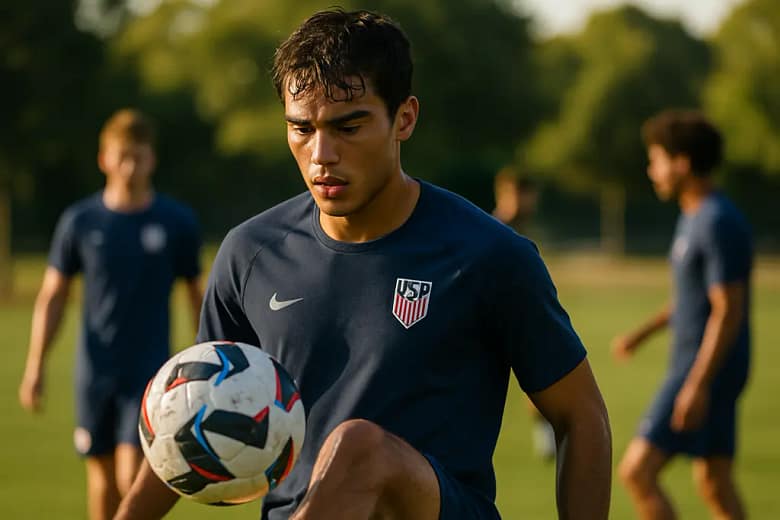
USMNT Youth Integration became one of the clearest themes of Mauricio Pochettino’s program after a run of roster decisions that gave young players senior minutes, public tests, and a wider competitive pathway. As of October 21, 2026, the record is no longer only about identifying prospects. It is about how the U.S. Men’s National Team used friendlies, tournament rosters, and a longer coaching contract to create evidence for future selection decisions.
Pochettino joined the USMNT as full-time head coach on September 10, 2024. On August 3, 2026, U.S. Soccer announced that he had agreed to a new contract through 2030, with expanded responsibilities touching youth development, coaching education, and player development pathways, according to U.S. Soccer’s announcement. That contract detail matters because youth integration can be shallow if it is limited to a single camp. A four-year cycle gives the federation a clearer structure for evaluating teenagers and early-20s players without making every appearance feel like a final verdict.
Why USMNT Youth Integration Became The Story
The case for USMNT Youth Integration rests on several reported data points from the 2025 and 2026 windows. Since Pochettino took over match management in October 2024, 62 different players earned caps under him, drawn from 16 leagues in 12 countries. That spread does not prove that every selection worked, but it does show that the staff widened the pool rather than relying only on a settled group.
USMNT Youth Integration And The Fall Window
The Fall Window of 2026 gave the strategy its sharpest public test. Across matches against Peru, Chile, Mexico, and Canada, the USMNT went 4-0. During that span, 13 players debuted, and the team scored 12 goals from seven different scorers. The same window included the fastest goal by a debutant in the modern era and the youngest goal scorer in team history, based on the research record provided.
The September 26, 2026 friendly against Peru was the most direct youth signal. Eleven players made their first USMNT appearance, including eight teenagers. All four U.S. goals in that match involved players making their debuts. That is a striking roster event, but it should be read carefully. A friendly allows space for testing that a knockout match may not. The value is not that every debutant should immediately become a senior regular. The value is that the staff created senior-team evidence under match conditions.
A Younger Roster With Real Competitive Stakes
The September-October 2026 roster had an average age of 22 years and 9 months, more than four years younger than the roster selected for FIFA World Cup 2026. Among the 28 players called for those matches, 13 were uncapped. Those numbers point to a staff willing to accept short-term uncertainty in exchange for broader evaluation.
That approach was not entirely new in 2026. During the 2025 CONCACAF Gold Cup, the USMNT roster had an average age of 25 years, 119 days as of its first match on June 15, 2025, making it the third youngest U.S. roster at a Gold Cup tournament start after 2021 and 2023. That group also included seven uncapped players. The through-line is important: the staff had already shown a preference for testing inexperienced players before the more dramatic Fall Window of 2026.
Roster Strategy And Player Access
For an athlete-rights advocate, the most important question is not only who gets called in. It is whether the pathway is fair, understandable, and connected to development rather than publicity. Teenagers can benefit from senior exposure, but they also carry the pressure of public judgment before their game is fully formed. The data from Pochettino’s USMNT points to broad access, yet the next standard should be whether those opportunities lead to clear feedback and repeat evaluation.
Debuts As Information, Not Coronations
USMNT Youth Integration should not be treated as a guarantee of permanent promotion. A cap gives the staff information: how a player handles tempo, physical duels, travel, senior communication, and tactical instruction. It also gives the player information about the gap between club promise and international execution.
That is why the 62-player pool matters. A wider pool can reduce the risk of overloading a small set of young stars, and it can give late developers a visible route. It also asks more from coaching education and talent identification. If players are coming from 16 leagues in 12 countries, the staff must compare very different club contexts with care. A teenager logging first-team minutes in one league and a young player breaking through in another may not be facing the same tactical or physical demands.
Record Setters And The Risk Of Hype
The record-setting goals in 2026 brought attention that the federation could not avoid. Mathis Albert became the youngest scorer in USMNT history at 17 years, 131 days on September 29, 2026 against Chile, breaking Christian Pulisic’s previous mark of 17 years, 253 days. Days later, on October 3, 2026, Cavan Sullivan scored in a 3-0 friendly win against Mexico at 17 years and 5 days, becoming the youngest USMNT goal scorer, as reported by The Washington Post.
Those milestones are significant, especially against regional opponents that carry emotional weight for supporters. Still, record-setting moments should not become the only measure of development. Sustainable national-team building requires room for ordinary performances, technical mistakes, and gradual improvement. That is a sports-first stance and an athlete-centered one: protect the player from being reduced to an age record.
Education, Player Welfare, And The 2030 Cycle

Pochettino’s contract through 2030 makes the education piece more than a side issue. U.S. Soccer’s announcement connected the extension to broader responsibilities in youth development, coaching education, and player development pathways. That phrasing matters because national-team progress depends on the daily environments players return to after camp.
What The Pathway Needs To Teach
If the federation is serious about USMNT Youth Integration, the lessons should be consistent across age groups. Players need to understand tactical demands, recovery habits, match preparation, and the difference between being selected once and sustaining a senior international standard. Coaches need shared language so that a teenager’s move from youth camp to senior camp does not feel like entering a different sport.
That education also connects to scouting volume. A wide player pool is only useful if the evaluation process is credible. The September-October roster’s average age and uncapped count showed openness, but future credibility will depend on whether players know why they were selected, what they must improve, and how they can earn another chance. For a related discussion of access barriers and U.S. youth scouting, Back2Tap has covered youth soccer development through the lens of national-team camps.
Data, Facilities, And Sustainable Development
Player development also has a sustainability angle. Better planning can reduce wasted travel, unclear camp purposes, and repeated short-term decisions. In sports organizations, technology and design choices increasingly shape how athletes train, recover, and learn. Readers interested in exploring a related topic across the same editorial network can find further insights at CAD CAM Net.
The caution is that data should support coaching, not replace it. The research record here shows roster ages, debuts, caps, goals, and league spread. Those are useful indicators. They do not fully capture whether a young player felt prepared, whether communication was clear, or whether the camp helped long-term growth. Responsible leadership should measure both performance outcomes and the quality of the player experience.
- Selection access: The program used debuts and a wide cap pool to evaluate more players.
- Education: The 2030 contract frame tied senior-team work to youth development and coaching pathways.
- Player welfare: Teen milestones should be celebrated without turning young players into instant finished products.
USMNT Youth Integration Under Pochettino
The strongest reading of Pochettino’s roster decisions is that the USMNT used 2025 and 2026 to make the player pool younger, wider, and more evidence-based. The Gold Cup roster in 2025 introduced a younger competitive group. The September-October 2026 roster pushed that idea harder, with an average age of 22 years and 9 months and 13 uncapped players. The Fall Window then gave the strategy results: four wins, 13 debuts, and major scoring milestones from teenagers.
That does not mean the process is finished. USMNT Youth Integration has to be judged over time by repeat call-ups, player development after first caps, and whether young athletes receive honest feedback rather than only public attention. The encouraging sign is structural: Pochettino’s deal through 2030 gives U.S. Soccer a defined period to connect senior selection with coaching education and youth pathways. The responsibility now is to make that connection work for the players, not just the scoreboard.