
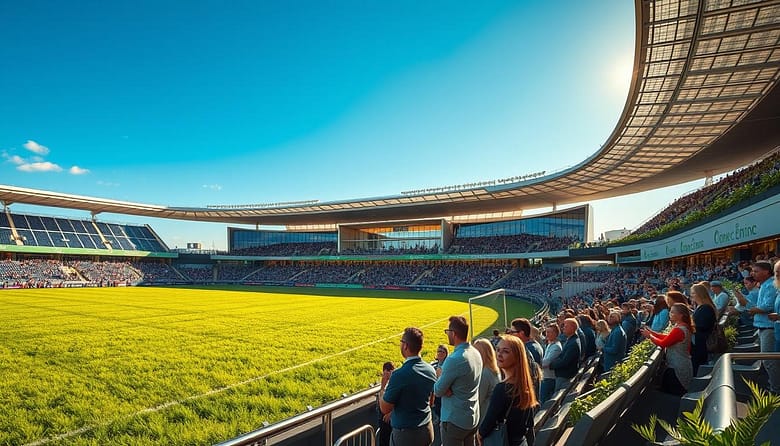
A political or corporate campaign promising a greener future looks weak if it’s held in a venue with diesel generators and single-use items. You can’t talk about a sustainable future from a stage lit by old, polluting lights. Today, the venue is the message.
Modern audiences are smart. They don’t just listen to your words; they look for proof. They search for solar panels, not just empty promises. A campaign’s true score isn’t just in its words; it’s in the venue’s design and energy.
The green stadium concept is more than just a building; it’s a big statement. It’s a 100,000-square-foot promise. A green stadium isn’t just a place; it’s a constant ad for trust. When a candidate or brand talks about a clean future from a facility powered by it, their message is clear.
It’s the difference between a candidate who talks about clean energy and one who uses it. The details—solar panels, water recycling, zero-waste—are more than just tech. They are the solid base of any believable 21st-century promise.
Energy (Solar, LEDs, BMS)
The modern stadium is more than just a place to watch sports. It’s a place where energy is made, stored, and used wisely. Gone are the days when stadiums used a lot of power without making any. Now, they aim to be energy-positive, like a well-oiled machine.
Solar and On-Site Generation
Stadium roofs are now covered in solar panels. This makes them into power plants. Venues like Johannesburg’s Soccer City and Munich’s Allianz Arena show this off.
It’s not just about adding panels. It’s about designing stadiums that make power. Canopies and parking lot awnings can also generate energy. Even Soccer City Stadium has special tiles that catch energy from fans’ movements.
This change isn’t just for show. It’s a big shift in how energy is used. When stadiums make a lot of their own power, they can even sell it back to the grid. This turns a cost into a way to make money.
Smart Grids and Storage
The real magic happens behind the scenes. A Building Management System (BMS) controls everything. It’s like a Swiss watchmaker’s dream. The BMS makes sure energy is used efficiently, like a conductor leading an orchestra.
Storage is key. The Johan Cruyff Arena in Amsterdam has a big battery. It’s like a power reserve. During big events, stadiums can use this stored energy, making them more reliable.
Let’s compare the old way to the new:
| Aspect | Old Energy Model | New Energy Playbook |
|---|---|---|
| Power Source | Passive consumer from the grid | Prosumer: generates, stores, and feeds back |
| Storage | None. Draws from grid during peak (expensive) hours. | Multi-MWh battery banks (like Johan Cruyff Arena’s 3 MWh system) |
| Management | Reactive, manual adjustments | AI-driven BMS that predicts and optimizes in real-time |
| ROI Focus | Minimizing utility bill | Revenue from grid services, peak shaving, and energy credits |
This isn’t just about being green. It’s about being smart and financially wise. The stadium of the future is a living, breathing asset. It’s not just a place to watch sports; it’s a power-generating hub.
Water (Irrigation, Fixtures, Reuse)
Forget sprinklers and halftime shows for a moment. The most strategic play in a modern stadium isn’t a trick play. It’s water management. We’re not talking about just saving water; we’re talking about reusing every drop.
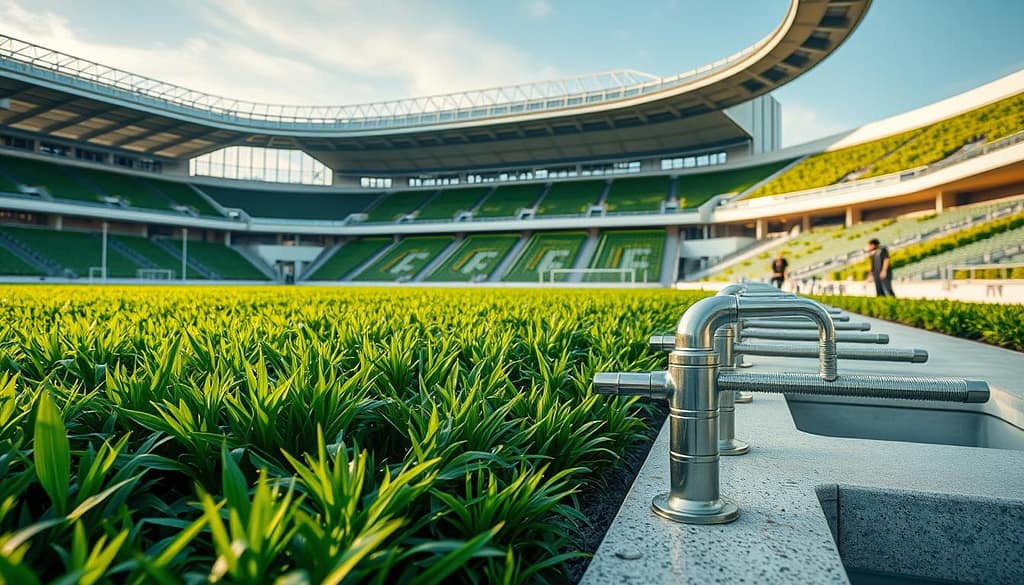
This isn’t about turning off the tap while brushing teeth. It’s about rethinking the water cycle on a stadium scale. It’s a shift from a wasteful model to a closed-loop system. In this new system, water keeps circulating. This strategy saves millions of gallons and is used by the smartest stadiums.
From Pitch Irrigation to Plumbing
It starts with the source. Instead of using drinking water for the field, why not use rainwater? Allianz Field in Minnesota has a 675,000-gallon cistern for this purpose. This water is perfect for irrigating the pitch.
Inside the stadium, the changes are clear. Low-flow faucets and toilets are now standard. But the real genius is in how these systems connect. At Mercedes-Benz Stadium, water conservation is part of a bigger sustainability plan. They view water as a resource to be managed, not just used.
The Closed-Loop Water Cycle
This is where it gets exciting. The ultimate goal is a complete, on-site water loop. Climate Pledge Arena in Seattle is the gold standard. They collect rainwater, store it, and use it to make ice for the NHL’s Seattle Kraken. This water is then recirculated, making the system a closed loop.
Levi’s Stadium in Santa Clara is another example. They use recycled water for irrigation and cooling towers. This is now the new standard. The table below shows how leading venues are closing the loop:
| Stadium | Water Reuse Strategy | Key Feature | Annual Water Saved (Est.) |
|---|---|---|---|
| Allianz Field | Underground cistern for stormwater capture & irrigation | 675,000-gallon cistern for pitch irrigation | 2.5 million+ gallons |
| Climate Pledge Arena | Rainwater-to-ice closed loop | Rainwater harvested, purified, frozen for NHL ice | ~5 million gallons* |
| Levi’s Stadium | Recycled water for cooling & irrigation | Uses recycled “purple pipe” non-potable water | ~8 million gallons* |
| Mercedes-Benz Stadium | Comprehensive water reduction strategy | Part of holistic sustainability and water reuse plan | Part of 47% water use reduction goal |
The story is changing. Water isn’t just a utility; it’s an asset to be managed. The stadium of the future has a water budget, not just a lower water bill. It views every drop of water as a resource. This model turns a stadium into a self-sustaining part of the urban water cycle. The goal is to be a net positive part of the ecosystem. The smartest players are already on the field, rewriting the playbook.
Materials and Waste Loops
In a world full of single-use items, the stadium of the future must be more than just a building. It needs to be a symbol of change. We must move away from the “take-make-waste” model and embrace a system where everything is part of a continuous loop. This is the essence of the green stadium: a place where life cycles are not ends, but new beginnings.
We’re not just talking about recycling bins at the concession stand. We’re talking about a complete redesign of the stadium’s DNA.
From Demolition to Design: The Circular Stadium
Imagine a stadium that can leave without a trace. The most sustainable material is the one you don’t need to create from scratch. The next step isn’t just recycled steel or FSC-certified wood. It’s about designing for disassembly from the start.
Think of it as the ultimate, high-stakes Lego set.
Stadium 974 in Qatar is a great example. It was built from 974 recycled shipping containers and designed to be unbolted and reassembled elsewhere. This is the “kit of parts” philosophy: a stadium as a modular, adaptable system. It’s the circular economy in action, where the end of one event is the start of another.
The Zero-Waste Game Plan
Building a zero-waste ethos from the ground up means treating waste as a design flaw. It’s not about finding a “greener” landfill; it’s about eliminating waste entirely. The 9 key secrets to starting a recycling program are a good start, but we need to think bigger. Let’s look at a real-world example.
The Kia Center in Orlando is a masterclass in the new material economy. They used 15% recycled materials, sourced 20% of materials within 500 miles, and diverted 83% of construction waste. This isn’t just a statistic; it’s a shift in how we think about materials.
It means concrete rubble becomes road base, old seats become park benches, and steel gets a second life. This isn’t just a “green” building; it’s a material bank, a reservoir of resources for the future.
The goal is to make the stadium a net-positive contributor to its environment. This isn’t just about a single venue. It’s about a systemic shift. The linear model—take, make, waste—is outdated. The circular model, where everything is a nutrient for the next cycle, is the only way forward for a true green stadium.
| Aspect | The Old, Linear Model | The New, Circular Model |
|---|---|---|
| Material Mindset | Virgin resources, designed for the dump. | Resources are borrowed, designed for disassembly and rebirth. |
| Waste | A costly byproduct to be managed and hidden. | A design flaw. The goal is zero waste, where “waste” is a resource. |
| Lifecycle | Build, use, demolish, landfill. | Design, use, disassemble, reuse, repurpose, repeat. |
| Example | A concrete bowl, demolished into rubble and sent to a landfill. | Stadium 974: a temporary, modular venue designed to be moved and rebuilt. |
| End of Life | Demolition and disposal, a cost and an environmental liability. | Deconstruction and resource recovery, an asset recovery program. |
The circular green stadium isn’t a dream. It’s a practical, hard-nosed strategy. It asks: can we build a venue that leaves a legacy of materials, not waste? The answer, as these pioneering projects show, is a definitive yes. The future of stadiums isn’t in the concrete they pour, but in the loops they close.
Fan Experience and Education
The old way of watching sports was just sitting and cheering. Now, stadiums are changing. They’re becoming places where fans learn and interact.
Every detail, from the food to the facilities, tells a story. It’s not just about watching the game. It’s about being part of something bigger.
The Fan as a Participant, Not a Spectator
Fans are no longer just spectators. They’re now part of the sustainability effort. It’s not just about watching; it’s about participating.
Imagine feeling the power of the solar array you helped generate. It’s a hands-on experience that connects you to the game and the planet.
At places like the Lincoln Financial Field, fans learn through interactive kiosks. They see how solar panels power the Jumbotron. It’s a real-time lesson in sustainability.
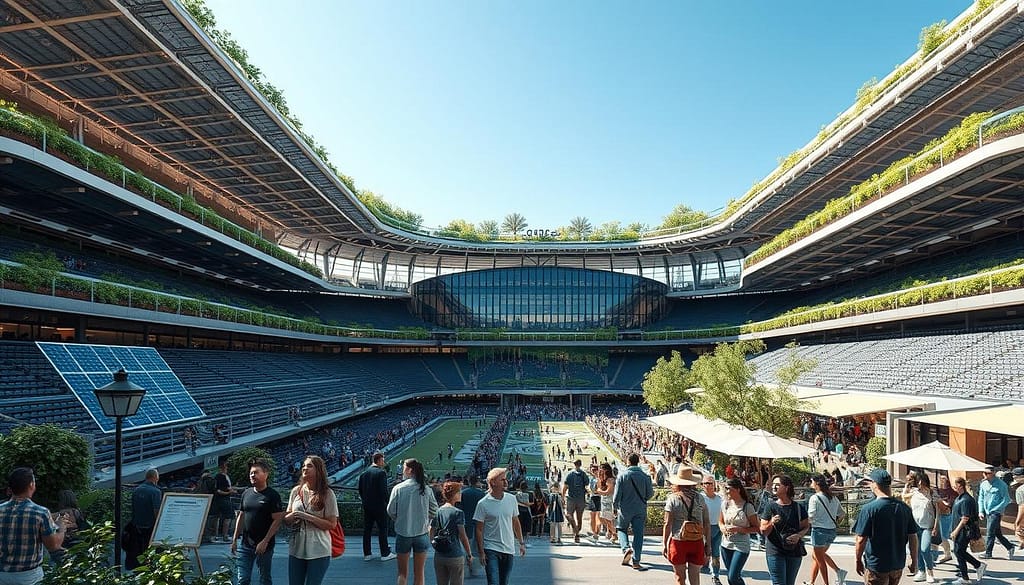
Even the smallest details matter. From compostable containers to recycling bins, every choice teaches a lesson. It’s not just about waste management; it’s about resource logistics.
Leaving the game, fans take home more than just memories. They learn about a closed-loop system. Their waste becomes the soil for future plants.
Stadiums are also teaching fans beyond the game. They offer tips on how to live sustainably. Environmental partnerships in sports help fans make eco-friendly choices.
Stadiums become centers for community values. They show how sports can lead in sustainability. This builds loyalty and a lasting legacy.
Financing and Grants
Let’s talk about the money needed for green stadiums. The cost of green steel, smart glass, and efficient systems can be high. But, sustainability is a smart investment that pays off in the long run.
The upfront cost is just the beginning. It leads to lower operating costs, new income streams, and a strong brand. This boosts fan loyalty and attracts sponsors.
The ROI of Green Steel and Glass
Green materials like steel and glass are long-lasting investments. The initial cost is a small price for future savings. This is where the narrative flips from cost to investment.
These materials save energy and money. Studies show sustainable buildings can be 21% more valuable. The Mercedes-Benz Stadium in Atlanta is a great example of this.
Grants, Incentives, and the Bottom Line
There’s help available to make green choices easier. You can get tax credits, rebates, and special funding for green projects. This turns a cost into a profit.
By selling energy credits and attracting green sponsors, you can make more money. This turns a cost center into a profit center.
To understand the financing better, here’s a breakdown:
| Financing Mechanism | Key Features | ROI Horizon | Best For |
|---|---|---|---|
| PACE Financing | Low-interest, long-term loans for efficiency upgrades, repaid via property tax. | Immediate (Cash Flow Positive from Day 1) | Deep retrofits, major system overhauls |
| Green Bonds | Fixed-income for large-scale projects, often with tax-exempt status. | Long-term (10+ years) | New construction, major expansions |
| Utility & State Rebates | Direct cash incentives for solar, LED lighting, and high-efficiency HVAC. | Immediate (Direct Cost Reduction) | Retrofits, lighting/HVAC upgrades |
| Federal Tax Credits (ITC/PTC) | Direct reduction in tax liability for renewable energy investment. | Immediate (1-3 years) | On-site solar, battery storage |
The story has changed. It’s not about if you can afford to go green. The market is asking if you can afford not to. The financing is there, the technology works, and the benefits are clear.
Case Studies with KPIs
Let’s dive into the real deal. These ideas aren’t just ideas; they’re proven winners. The stadiums aren’t just buildings; they’re examples with solid KPIs showing the model works.
Mercedes-Benz Stadium, Atlanta
This stadium is more than a place to watch games; it’s a symbol of sustainability. It was the first sports venue to get LEED Platinum. But it didn’t stop there. It also got TRUE Platinum for being zero-waste, sending over 90% of waste to recycling.
The key number here? Over 2,000 tons of waste saved. That’s not just a number; it’s a new benchmark.
Climate Pledge Arena, Seattle
This arena is the gold standard for going green. It runs on 100% renewable energy. Its standout KPI? It diverts 99.8% of waste.
The coolest part? The ice for NHL games comes from rainwater collected on its roof. It’s a system where everything is recycled, ending with a net-zero carbon score.
Tottenham Hotspur Stadium & The Kia Center
Proof is in both new and old builds. Tottenham Hotspur Stadium in London has a zero-waste policy. It’s also a community center, showing social value. The Kia Center in Orlando, a retrofit, shows you can make a difference without starting from scratch. It recycled 83% of construction waste.
The main message isn’t just numbers; it’s a new strategy. The future’s scorecard isn’t just about winning games. It’s about the energy saved, water used, and waste cut down. The plan is clear, and the results speak for themselves.