Commanders Stadium Development has moved from political agreement into project delivery, and that shift matters for athletes, fans, workers, and residents near the RFK campus. The project is not just a future NFL venue. It is a major public-facing sports infrastructure plan tied to housing, parks, transportation pressure, construction sequencing, and neighborhood trust.
As of October 3, 2026, the main facts are clearer than the open questions. The Commanders have selected key delivery partners, the District has released a draft master plan, site enabling work began in June 2026, and the target for completion remains Q2 2030. The caution is equally clear: public benefits, parking design, cost controls, and construction phasing will determine whether the project earns confidence beyond game days.
For sports leaders, this is where industry leadership has to mean more than a new building. A stadium is an athlete workplace, a fan gathering point, and a civic asset. The management test is whether the development process protects community needs while giving the team a modern home with the operational standards expected in the NFL.
Commanders Stadium Development And Project Controls
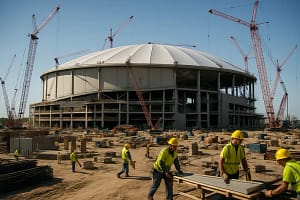
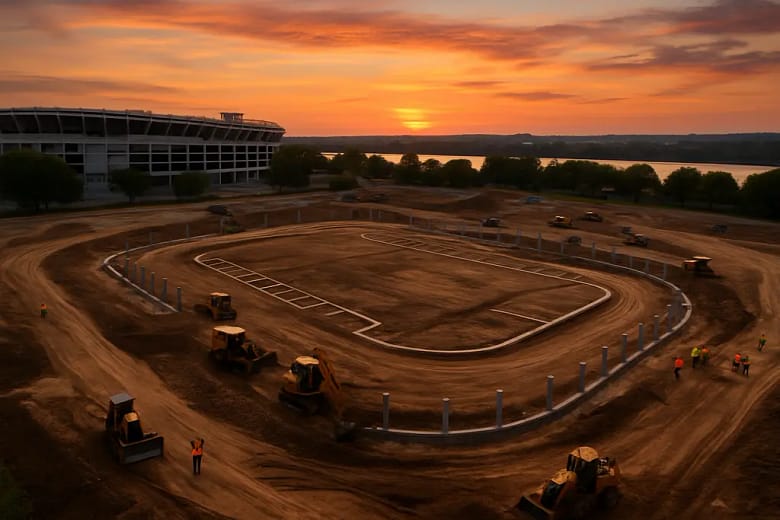
The project structure now includes a defined builder, design leadership, and owner-side management. On August 11, 2026, the Commanders announced that a joint venture of Clark Construction Group, Mortenson, and Smoot Construction Company had been selected to build the stadium. The team said the venue would be about 1.8 million square feet on the former RFK Stadium site, with site enabling work that began in June 2026, below-grade core stadium construction planned for spring 2027, and completion targeted for spring or Q2 2030, according to the Commanders stadium announcement.
That timeline puts pressure on coordination. A 1.8 million-square-foot NFL venue is not managed as a stand-alone sports project once it is tied to housing, open space, riverfront access, parking, and public infrastructure. The District PM Alliance, made up of Brailsford & Dunlavey, CAA ICON, and McKissack & McKissack, was selected as owner’s project manager on September 3, 2026, with oversight across design, construction, infrastructure, and stakeholder coordination.
What Commanders Stadium Development Requires From Managers
For Commanders Stadium Development, the core management task is sequencing. Site work, below-grade construction, design review, utility coordination, neighborhood planning, and public benefit obligations have to be tracked against dates that are visible to the public. If deadlines move, the reason should be stated plainly. If design choices change, residents should be told what changed and what trade-offs were weighed.
This matters for athlete rights as well. Players benefit from venues that support safe preparation, movement, recovery, and game-day operations. Those internal team needs should not be treated as separate from public planning. A well-run venue project can support athletes while also reducing avoidable friction for workers, nearby residents, and fans arriving on crowded event days.
Schedule Risk And Public Accountability
The D.C. Council gave final approval on September 17, 2025, by an 11–2 vote after negotiations that included binding deadlines, cost-overrun responsibilities, and community benefit mechanisms. The same public record also points to a concern: some fixed dates for neighborhood and mixed-use parcel construction were replaced by rolling deadlines tied to zoning approvals. Research notes indicate that some neighborhood development parcels may not be built until the 2040s.
That is not a minor detail. Stadiums often open before surrounding promises are fully delivered. If the field, suites, concourses, and team spaces arrive years before housing, parks, and neighborhood amenities, the public may judge the project by what came first. Project controls should therefore track the stadium and non-stadium commitments together, not as separate stories.
Community Engagement At The RFK Campus
The District’s draft master plan, released on June 30, 2026, said it incorporated input from more than 1,700 people across 33 separate events. The plan also described a broader RFK campus proposal that included a major private investment by the Commanders and an overall deal estimated at $3.7 billion to $3.8 billion, with the team investing at least $2.7 billion, according to the District’s RFK campus master plan release.
Those engagement numbers are meaningful, but participation counts are only the start. The test is whether feedback changes design, phasing, access, and mitigation. Residents raised issues around parking structures, neighborhood impacts, and visual massing. Those concerns deserve direct responses because the RFK campus is not an isolated stadium parcel; it sits inside a lived neighborhood with daily traffic, school routes, local parks, and river access.
Housing, Parks, And Access Commitments
The master planning figures in the research point to a mixed-use campus, not only a football venue. HKS was named lead architect on November 13, 2025, and the design framework includes thousands of new homes. Research notes cite ranges of 5,000 to 6,000 homes in one project description and 5,500 to 6,500 new housing units across the campus in another, with 30% reserved as affordable under the master plan framing.
The open-space commitments are just as central. The plan designates at least 30% of the 180-acre site to green space, parks, and recreation, with emphasis on riverfront access, public plazas, and youth sports facilities. For a sports-first project, youth fields and recreation access should not be treated as decorative features. They are part of the public return, especially in a city where access to safe, quality playing space affects participation.
Parking Design And Neighborhood Pushback
Parking is now one of the clearest pressure points. The National Capital Planning Commission reviewed preliminary design concepts in early 2026 and raised concerns that included garage heights, sightlines, parking deck massing, stormwater, and noise. On October 1, 2026, designs for two tall parking garage decks drew criticism from local communities at an NCPC hearing, based on concerns over visual impact and neighborhood effects.
The parking debate shows why community engagement has to continue after headline approvals. Fans need workable access on game days, but residents should not carry an unexamined burden from structures that shape the area every day of the year. Better project leadership would show how parking demand, transit access, pedestrian routes, stormwater planning, and neighborhood design are being balanced with evidence rather than slogans.
Sports Industry Lessons From The RFK Plan

The sports industry should read this project as a case study in governance. Commanders Stadium Development is being watched not only because Washington is an NFL market, but because the project combines a team relocation back to a symbolic site with public planning and large private investment. A stadium deal of this scale can set expectations for how clubs communicate with cities and residents.
For a broader perspective on how football culture and venues are managed globally, readers can also explore worldfootballidol.com, a related site in the same network. The useful lesson across sports is consistent: stadiums succeed as civic assets when access, scheduling, public space, and local benefit are managed with the same seriousness as premium seating and broadcast requirements.
Community Benefits Need Clear Measurement
The D.C. Council pushed for approximately $779 million in additional concessions from the team, including a $50 million community benefit package. Those figures should be tracked in public terms that residents can understand. A benefit package is strongest when it shows who receives support, when funds are deployed, which obligations are complete, and what remains unresolved.
That transparency is also fair to the team. Clear measurement can separate delivered commitments from assumptions and political messaging. If the Commanders meet milestones, the public record should show it. If commitments slip, residents should not have to depend on scattered hearings or late-stage news reports to understand why.
Sustainability Should Be Built Into Operations
The RFK plan’s green space, parks, recreation areas, and riverfront access give the project a sustainability frame, but environmental performance will depend on execution. Stormwater concerns raised during review are a reminder that sustainability cannot be limited to renderings. It has to show up in engineering, maintenance, construction choices, and long-term operations.
From an athlete-rights perspective, sustainability and human performance are connected. Heat, air quality, travel routes, practice access, recovery spaces, and safe crowd movement affect the people who work inside sports venues. A responsible stadium plan should treat players, event staff, youth athletes, and residents as part of the same operating system.
Commanders Stadium Development Accountability
The best case for the RFK project is straightforward: a modern NFL stadium, a better fan arrival experience, new housing, affordable units, public parks, youth sports spaces, and improved riverfront access delivered through disciplined project management. The risk is also straightforward: the stadium opens on schedule while the community-facing parts lag, shrink, or become harder to verify.
Commanders Stadium Development now sits in the accountability phase. The major partners are named, the draft master plan is public, community concerns have been voiced, and the clock is moving toward spring 2027 core construction and Q2 2030 completion. The next measure of leadership is not another announcement. It is proof that the project can keep faith with the people who will live, work, play, and compete around the RFK campus long after the first kickoff.